 |
| This Australian hotel was not included on Linda Zavoral's list. (Image: tripadvisor.com.au) |
Showing posts with label San Jose Mercury News. Show all posts
Showing posts with label San Jose Mercury News. Show all posts
Sunday, November 10, 2013
World's Manliest Hotels


Monday, September 2, 2013
US Economic "Recovery": A Tale of Two Workforces
 |
| Graph: motherjones.com |
A story in today's San Jose, California-based Mercury News discusses the phenomenon of the have-less, and focuses on issues "older workers" face. The bleak news, quietly tucked away on a low readership national holiday weekend, is sobering. The article summarizes its points as follows:
- A recovery that for many older workers doesn't feel like one.
- Two-thirds of baby boomers between ages 55 and 64 who found work after losing it in the recession are making less than they did in their previous jobs.
- Their median salary loss is 18 percent, compared with a 6.7 drop for 20- to 24-year-olds.
- The re-employment rate for this older age group is 47 percent, and 24 percent for those over 65, versus 62 percent for 20- to 24-year-olds.
- Finding another job takes far longer, too: 46 weeks for boomers, compared to 20 weeks for young workers.

is complicated by a triple whammy of wage stagnation, a dramatic growth of low-wage jobs in hospitality and food services, and the staggering number of jobs lost in California during the recession -- 1.4 million, nearly half of which have yet to come back.The California report could easily be repeated in nearly every other state in the Union. Does this sound like "progress" to you?
Monday, April 8, 2013
IRS Considers Taxing Perks At Iconic Silicon Valley Firms
 |
| Photo: applieddatalabs.com |
One former Google employee was quoted as maintaining the free food was not "compensation," but "a phenomenal convenience..." Apparently, that line of reasoning was sufficient to dodge the taxman. Meanwhile, the Mercury News article cited a story from the late, lamented Gourmet magazine raving about the Google dining room's sensational cuisine, including "'porcini-encrusted grass-fed beef.'" That's not exactly "convenience" food. Some of the Valley's employees and chefs claimed the high-quality dining was essential to a firm's culture, growth prospects, and hiring attractiveness.
The meals were for everyday employees, and not restricted to executive dining rooms. Somehow, the brains that turn out the secret sauce known as "proprietary algorithms" could not possibly function effectively without tax-free meals. The tech firms and their satellite dependencies would have one believe that instituting a government levy on corporate cafeterias would somehow diminish the appeal of working in the global epicenter of technological innovation. Sorry, I'm not buying it.
I admit I typically don't pay tax for my work lunches. Then again, I usually bring my own lunch from home. I manage.
Wednesday, August 29, 2012
California Legislature Considers Bill to OK Robot Cars on Public Highways
 |
| Google's "driverless car" (photo from Edmunds Inside Line) |
Well, the California legislature is currently considering a motion that would permit robot-driven vehicles to travel on the state's public highways. The measure has already passed the state assembly and is expected to reach a state senate vote soon, according to a story in today's San Jose Mercury News. Governor Jerry Brown is expected to sign the measure.
The notion of robot-driven cars is not far fetched. Google engineers and their Stanford University counterparts have each created and tested vehicles in which computers do the driving. There does seem a sense of inevitability about humans taking a figurative back seat. According to the Mercury News story, humans can intervene during the drive. I suppose that offers some comfort, but computers don't handle "watch out" warnings very nimbly.
The story also raised a number of intriguing issues, such as insurance liability and legal culpability in the event of an accident. The possibility of issuing a moving violation to a computer was great fun to contemplate. Finally, the article raised the question of a computer crash leading to a vehicle crash. And, despite the smug assurances of electrical engineers, computers do crash, sometimes with disastrous results.
If I were a hitchhiker, I would view computer-driven cars with distaste. The chance of a robot vehicle stopping to pick up someone with their thumb out are nearly zero. Driverless hitchhikers, along with other extraneous "human elements," just don't add up for a computer-driven vehicle.
Monday, July 23, 2012
Former Yahoo CEO Scott Thompson Lands New Job
 |
| Scott Thompson |
Of course, most people who get caught lying about their resume generally don't get rehired a few weeks after the fact. I would think that would be especially true for a highly publicized case, such as Thompson's. However, the former Yahoo boss has many friends in the tech world. He also might be a value pick that ShopRunner's sharp-eyed owner may have plucked from the scrap heap.
Stranger things have happened on the road to reputational rehabilitation.
Monday, July 16, 2012
Facebook's Mark Zuckerberg Gets 1.05% Home Mortgage

The tech world's wunderkind, according to a story in the Mercury News, refinanced his Palo Alto digs with "a 1.05 percent adjustable rate mortgage on a loan of $5.95 million"from First Republic Bank.
Friday, July 6, 2012
Silicon Valley History Video Released
 |
| Silicon Valley Birthplace Marker (photo from LA Times) |
I haven't seen the series, but it's tempting to want to pay to see the content. Journalist Mike Cassidy wrote a fun story in today's Mercury News about the video series. Check it out: The article includes video samples from McLaughlin's work.
Wednesday, July 4, 2012
Judge Rules Twitter Must Provide Tweets, IP Addresses to Prosecutors
 |
| Malcolm Harris |
The defendant, Malcolm Harris, is charged with disorderly conduct stemming from Occupy Wall Street activities.
Twitter fought the court order to compel disclosure.
Sunday, June 24, 2012
New Wi-Fi Protocol to Triple Data Speeds
 |
| Broadcom has produced 5G capabilityin its wireless chips |
That's the new Wi-Fi protocol intended to upgrade wireless coverage inside one's home, according to a story in today's siliconvalley.com, a website affiliated with the San Jose Mercury News.
The major push for this Wi-Fi boost comes from the insatiable demand for video. What's fascinating is the article's note that "one million minutes of video content will race across networks every second by 2015, and the number of gadgets connected to the Internet will be twice the world's population. Between 2010 and 2015, mobile data traffic is expected to soar 26 times."
The implication is that the tech industry believes its infrastructure for the sexy data flows will keep pace with the public's service expectations. Better hope the industry's optimism is justified.
Thursday, June 14, 2012
New NBA Franchise Owner Has Tech Roots
 |
| Robert Pera (photo from Forbes, which received it courtesy of Mr. Pera) |
Nonetheless, David Stern let Pera join the club, so to speak. The other three tech wizards who can claim ownership of an NBA team are Paul Allen (Portland Trail Blazers), Mark Cuban (Dallas Mavericks), and Joe Lacob (Golden State Warriors).
The San Jose Mercury News ran an interesting profile on Pera, noting his self-made man status and his business acumen.
While Pera is making his introductions in the NBA, so is the pro basketball franchise in Oklahoma City. What Commissioner David Stern probably won't like to discuss is how OKC moved from Seattle. It's a tawdry story, complete with back room dealings and saddened fans. Les Carpenter wrote in Yahoo!Sports today about the sale of the Seattle franchise and its move to Oklahoma. Included in the meandering, yet interesting article are comments by Shawn Kemp, who was once a star for the Seattle team and now owns a bar in the Emerald City.
Friday, June 1, 2012
Promoters of Seasteading Meet in San Francisco

"Seasteaders" are currently meeting in San Francisco to discuss and celebrate their ideas for creating these artificial island oases. The San Jose Mercury News has covered the story, noting some of the Silicon Valley wizards and financiers involved in the event.
What's so striking about the participants' goals and ambitions is their reasoning for embarking on such a project. Their stated (pardon the pun) common denominator is a concept of freedom hatched in libertarian philosophy. The world, in their view, has become a hopelessly restrictive arena. Their proposed, man-made islands would presumably create the libertarian paradise these partisans to the cause so devoutly desire.
There's something profoundly sad about this phenomemon. These disaffected libertarians often possess considerable wealth. They're largely free to do whatever they want. Yet, the messy, demanding world continues, in their view, to be inconvenient, even obstreperous. The inability of these libertarians to reconcile themselves to those that do not share their political and philosophical perspective creates a sense of melancholy, combined with a craving for release from the coarse, gross everyday world. The subsequent desire to a more "pure" environment leads to schemes for the realization of utopian ideals.
 |
| The Swimming City an example of a seastead |
The Seasiders, over time, might make a different, unwanted contribution to the American story. It's entirely possible the "Big One" Californians have dreaded may shake San Francisco right into the Pacific. Then the island Seasteaders can reinvent the Atlantis myth for their island-born grandchildren.
Tuesday, May 29, 2012
Sotheby's To Auction Original, Working Apple 1 Computer
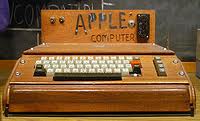 |
| Apple-1 computer |
In the coming days, Sotheby's will auction off a rare, bootable original Apple-1 computer. According to a Mercury News article about the event, the auction is expected to draw some deep pocketed collectors. Their entry into the realm of computer collection is a relatively new, expensive development.
Mechanical devices always seem to find a following. When I was in high school, my best friend collected phonographs, old recordings, and musical instruments. All three categories didn't simply sit on a shelf: he actively played and used what he bartered for or bought outright. To have witnessed my friend's delight on obtaining a rare phonograph remains a sweet memory.
Hopefully, the Apple-1 will find a new home and an appreciative owner who won't purchase the computer simply, and coarsely, for its supposed "investment value."
PS. Sotheby's auctioned the Apple-1 for the "hammer price" of $310,000; the actual payment price was higher, as the auction house's fee and taxes needed to be added to the purchase price. According to the Mercury News feature on the sale, one computer collector asserted the auction price "'takes us across a boundary line to where you have to start looking at these things as art pieces, like Monets.'"
PS. Sotheby's auctioned the Apple-1 for the "hammer price" of $310,000; the actual payment price was higher, as the auction house's fee and taxes needed to be added to the purchase price. According to the Mercury News feature on the sale, one computer collector asserted the auction price "'takes us across a boundary line to where you have to start looking at these things as art pieces, like Monets.'"
Friday, May 25, 2012
Do You Know "Pinger"?
 |
| Greg Woock (left) and Joe Sipher, Pinger's co-founders (photo from Forbes) |
The brains behind the operation is Greg Woock. His background is a little different from the characteristic Silicon Valley profile, in that he's not an engineer nor does he have an MBA. If you're unfamiliar with Woock and with Pinger, take time to read the brief interview the interesting San Jose Mercury News reporter Peter Delevett recently conducted with Woock. You'll find, as I did, Woock is a breath of fresh air in the Valley's hothouse environment.
Saturday, May 12, 2012
Yahoo CEO Blames Exec Search Firm for His False Credientials
 |
| Yahoo CEO Scott Thompson (photo from CNN) |
This story has overtones of Tom Cruise's character in the movie Magnolia (Frank T.J. Mackey) portraying his dodgy academic background. However, Scott Thompson's tale gets even better than anything movie director P.T. Anderson dreamed up. The San Jose Mercury News' Pete Carey reported that Thompson is now claiming an executive search firm "wrongly included a computer science degree in his background data years ago." (The executive search firm's stance on Thompson's assertion was not noted in Carey's article.)
One can infer that either Thompson did not read material the search firm prepared or he is prevaricating. Also, noboby, including former employers such as Pay Pal, took time to fully vett Thompson's credentials. At least Pay Pal apparently asked for a resume. According to Carey's story, Yahoo didn't even bother to do that. Given these facts, do you wonder what other skeletons are in the closets of America's supposedly best and brightest?
Wednesday, April 11, 2012
Texas City Gets Eyeful of Nude Maid Service
 |
| National Ranching Heritage Center, Lubbock TX |
There are now three maids on staff. While her firm's rates are $100 per hour for one maid, Borrett does offer a discount to law enforcement.
Thursday, March 8, 2012
Girl Scout Cookie App Now Available
 |
| Girl Scout Cookies poster, circa 1950s (image from the Washington Post) |
The personal touch always seemed essential to the ritual of Girl Scout cookies. That's why I was so surprised to read a story in today's online edition of the San Jose Mercury News about an app for Girl Scout cookie purchases. And, yes, you can now use a credit or debit card to pay for your sweet GS indulgences. I suppose it's a sign of the times, but buying Girl Scout cookies still needs the inefficient, but sweet human touch rather than going through the motions with an efficient, but soulless app.
Saturday, February 25, 2012
Dorothea Lange Photos Depict World War II Japanese-American Internment
 |
| Just About to Step into the Bus at the Assembly Center Dorothea Lange, 1942 (photo from Sacramento Bee and Oakland Museum of California collection) |
Nonetheless, Lange undertook the project. Unsurprisingly, her images were suppressed during the war years. They are available for viewing now. The San Jose Mercury News has collected sixty-five photographs from Lange's project, along with an interactive map identifying Bay Area photo locations that could be positively identified. Some of the photos are moving, some are beautiful, and all share a very scary context. Yes, it could -- and did -- happen here.
For a comprehensive look at Lange's work, the Oakland Museum of California is the place to visit. The photographer bequeathed 25,000 of her images to the institution; some of them are available to view online now.
Wednesday, February 15, 2012
Asking Price for Jeremy Lin Middle School Yearbook in the Thousands
 |
| Jeremy Lin |
Apparently, anything Lin touched has become valuable. The San Jose Mercury News reported that enterprising people have put their Palo Alto, California middle school yearbook, complete with photographs including the young Lin, for sale. According the the Mercury News story, the asking price for an unsigned middle school yearbook is over two thousand dollars. You have to double down to get a copy Lin allegedly autographed.
What would you pay for a piece of Harvard's second NBA player?
Thursday, January 19, 2012
Apple Makes Its Move Into Education Publishing's Fortress

Apple, in a splashy New York announcement, made a strong move into reshaping education publishing. In essence, Apple has attempted to reshape aspects of learning via its software's ability to combine video, text, and (ahem) existing materials into a unique "textbook." One key impact is in the area of "personalized learning," a current and very hot buzzword in education.
Apple found big-time education publishing allies for the initiative. One interesting overview of today's events, with some hyperbole, appears in the San Jose Mercury News.
Apple's salvo into educational publishing will have its strongest immediate impact among college and high school students and faculties. However, the Cupertino firm has its eye on younger students, whose "personalized learning" will require much more trained, adult management.
For all the fuss over the entry of gadget-enhanced education, the fact remains students will still need to master readin', writin', and 'rithmetic. Those challenges are eternal ones that resist "abracadabra" solutions.
Friday, January 13, 2012
Silicon Valley's Historical Electric Treasures

Subscribe to:
Posts (Atom)


