Showing posts with label Yahoo. Show all posts

Saturday, June 6, 2015

Yahoo To Fold Its Maps Page

Yahoo billboard in San Francisco,
removed in 2011.
In a telling sign of the times, Yahoo will shut its maps page at the end of June 2015. The news, initially released via a Yahoo blog post, was reported by AP and reposted in siliconvalley.com.

Yahoo's strategic rationale is its focus on generating advertising revenue. One can suppose that Yahoo Maps just didn't have enough ROI to justify continuing the service. The unspoken reason is that Google Maps profoundly benefits from the Mountain View company's search dominance. Yahoo and former Google exec Marissa Mayer knows that unpleasant rationale as well as any Yahooligan.

Marissa Mayer
(Image: wikipedia.com)
She has made a public show of moving Yahoo into "more profitable" areas, with the recent NFL deal providing Exhibit A. That's fine, but Yahoo's larger problem, which Mayer has not solved, is its inability to dominate any business category. Google owns search and video (thank you, YouTube); Amazon commands e-commerce; Facebook has corralled the friends and family networks; Apple has a private and highly lucrative mobile-savvy customer base.

Yahoo has its merits, starting with its excellent Finance site that manages to be useful for the retail investor as well as some pros. However, one gets the sense that Yahoo is increasingly bringing up the rear, with little innovation, not much pizzaz, and declining interest. I admit to some sentimentality regarding Yahoo. I've used the service for years and can recall its golden years. Those times, of course, are long gone, but the brand still resonates for me. Its allure, though, is diminishing. That's bad news for any brand, but especially one for which "ahead of the curve" is both the essence of its value proposition and its survival mantra.

Monday, July 23, 2012

Former Yahoo CEO Scott Thompson Lands New Job

Scott Thompson
The first of Yahoo's three CEOs for 2012 has found a new job. Scott Thompson, who was forced to leave Yahoo after allegedly misrepresenting his prior employment experience, is now the big banana at ShopRunner. Thompson's new firm provides "shipping perks from a variety of websites," according to a story in today's Mercury News.

Of course, most people who get caught lying about their resume generally don't get rehired a few weeks after the fact. I would think that would be especially true for a highly publicized case, such as Thompson's. However, the former Yahoo boss has many friends in the tech world. He also might be a value pick that ShopRunner's sharp-eyed owner may have plucked from the scrap heap.

Stranger things have happened on the road to reputational rehabilitation.

Saturday, May 12, 2012

Yahoo CEO Blames Exec Search Firm for His False Credientials

Yahoo CEO Scott Thompson
(photo from CNN)
The Yahoo CEO story is a gift that keeps on giving. I noted in a blog post earlier this week how a Yahoo board member has significant ties to Las Vegas gaming interests. The latest Yahoo installment involves Scott Thompson, the embattled Yahoo boss, and his false academic credentials. Thompson's background information, filed with the SEC and signed by Thompson, stated he had earned a computer science degree. In fact, Thompson does not, and never had had, a computer science degree.

This story has overtones of Tom Cruise's character in the movie Magnolia (Frank T.J. Mackey) portraying his dodgy academic background. However, Scott Thompson's tale gets even better than anything movie director P.T. Anderson dreamed up. The San Jose Mercury News' Pete Carey reported that Thompson is now claiming an executive search firm "wrongly included a computer science degree in his background data years ago." (The executive search firm's stance on Thompson's assertion was not noted in Carey's article.)

One can infer that either Thompson did not read material the search firm prepared or he is prevaricating. Also, noboby, including former employers such as Pay Pal, took time to fully vett Thompson's credentials. At least Pay Pal apparently asked for a resume. According to Carey's story, Yahoo didn't even bother to do that. Given these facts, do you wonder what other skeletons are in the closets of America's supposedly best and brightest?

Tuesday, May 8, 2012

Yahoo Board Member Patti Hart's Las Vegas Connections

Patti Hart
(photo from IGT)
Yahoo board members and parade of senior management have seemingly worked overtime to ruin a once proud firm's reputation. Their troubles began when founder Jerry Yang, with the strong backing of Google, thumbed his nose to Microsoft's friendly buyout proposal. That misjudgment cost Yahoo shareholders a bonanza. However, Yang maintained Yahoo's purity for a time. Meanwhile, Yahoo's performance continued to melt as Google cynically turned up its competitive heat. A new CEO, Carol Bartz, was brought in to change Yahoo's decline. The foul-mouthed (by all accounts) Bartz lasted awhile, until Yahoo's downward spin began to dangerously accelerate. A new CEO, Scott Thompson, was found and duly sworn in, partly to begin the mass layoffs everyone knew Yahoo needed to start. His major Yahoo board backer was Patti Hart, CEO of International Game Technology (IGT).

This week, the tech world tuned into the latest edition of the Yahoo soap opera. It appears Thompson misstated his academic credentials. He appeared to claim, and Yahoo asserted in documentation to the SEC, that he had obtained a computer science degree from an obscure Massachusetts college. A hostile Yahoo board member bothered to perform due diligence and discovered Thompson did not earn a computer science degree anyplace. As Thompson's de facto sponsor, Hall took the very public fall.

Si Redd (photo from Las Vegas Sun)
What's much more curious to me than Thompson's possible duplicity is Hall's background. IGT is a major player in the slot machine business. Its founder, Si Redd, is associated with the invention of video poker. Neither business is one for the faint of heart.

Inquiring minds wonder what Ms. Hart and her Nevada cohorts found so appealing about Yahoo. Clearly, Yahoo's international reach would have been a tempting target for a street-smart enterprise keen on international, Internet-based growth. Having a "family member," so to speak, on the board gave these sharp wits a tremendous, insider advantage. If any group understands the value of "early information," it's Las Vegas investors.

For a wickedly fascinating profile of Ms. Hart, read Sarah Klaphake Cords' piece in the December 2010 issue of Gaming Enterprise Management. For a mostly critical perspective on Hart's stacking IGT senior management with "her people," click to Las Vegas Review-Journal staffer Howard Stutz' column on Hart's hiring of IGT's chief financial officer.


Tuesday, December 6, 2011

Rome Removes Giant Papier-Mache Christmas Tree

Controversial Roman Christmas tree (photo from La Repubblica)
Rome, reeling from the Euro crisis and the country's sovereign debt crisis, responded swiftly to a controversy about a Christmas tree. According to an Agence France-Presse story appearing in Yahoo, the Italian capital's city council decided to remove a massive white papier-mache holiday tree after the item had one day in the public eye. The tree, located in the Eternal City's equivalent of Times Square, resembled an inverted ice cream cone. Apparently, its design, characterized by the Roman daily La Repubblica as "postmodern," was considered in poor taste. (La Repubblica has 13 photos of the tree, and they're worth checking out.)

The episode reminds me of arguments over the virtues of "real" versus artificial Christmas trees I've had over the years. For a long time, I was in the traditionalist camp. I grew up in a town where my two brothers once went into the nearby countryside, chopped down a tree, and brought it back on a sled. It was unthinkable, until a few years ago, to have an artificial Christmas tree in my home. However, I finally relented and we purchased a fake tree.

It's standing in our living room now, in the throes of being decorated. I've learned to appreciate and even like the artificial tree. It's not as elegant or as self-consciously avant-garde as the Roman version. Then again, I think the Romans, a notoriously opinionated lot, would rather have something like our tree.

Saturday, December 3, 2011

2011's Top Ten Search Terms on Yahoo, Facebook, and Bing; Yahoo to Terminate Its Iconic Bay Area Bridge Billboard

Did you every wonder what people search for online? Well, the owners of search engines do more than wonder. They keep stats on the public's taste for the truth. Around this time of year, results are released. So, for fans of Kim Kardashian, Lindsay Lohan, and other celebrities who haven't met a camera they haven't liked, ABC News has a report offering a summary of the 2011 search result data for Yahoo, Facebook, and Bing. Dig in and go crazy!

Yahoo's Iconic Billboard Near Bay Bridge Entrance
PS. The San Jose Mercury News reported in today's online edition that Yahoo's billboard at the eastbound I-80 approach to the Bay Bridge will be dismantled. Yahoo, according to the story, has been tightlipped about the report.

Why would Yahoo drop the billboard? Keep in mind the sense that Yahoo is in play, with buyers circling the firm like so many sharks sensing an available victim for their commercial appetites. Perhaps Yahoo is sending the world a signal that times are changing at the still very valuable search firm.

Saturday, November 12, 2011

Google Keeps Iron Grip on Search Engine Market

According to a Dow Jones report reprinted in today's Chicago Tribune, Google continues to maul any and all competitors in the Internet search business. Nearly 2 of every 3 searches is handled by Google, with #2 Yahoo getting 15% of the market. Microsoft's Bing and other search endeavors came in third place, with slightly under 15%.

Yahoo, once the Cadillac of search engines, continues to lose its mojo. Its most recent site change made a manageable experience much more annoying while not improving anything at all. Yahoo recently fired its brash CEO, Carol Bartz, and the M&A sharks now smell blood. Of course, Yahoo could have taken Microsoft's generous buyout offer a few years ago and lived happily ever after. Incredibly, major Yahoo shareholder Jerry Yang took the advice of its principal competitor, Google, and backed out of the deal. Since then, Google, without having to worry about Microsoft's cash and clout, continues to erode Yahoo's value.

One can only now hope that Yahoo isn't dismembered by its Asian investors and Yahoo's probable private equity partners. It would be a sad end to a once wonderful brand. Also, as a practical matter, the notion of search effectively monopolized by one firm is simply not in the public interest. "Too Big to Fail" is not only relevant in the finance world: it's especially pertinent in Internet communication.

Saturday, October 8, 2011

Steve Jobs Passing and Impact on Twitter, Google Search Traffic Flow, Info Management


It's no secret that the Internet was awash with activity in the minutes, hours, and days after the announcement of Steve Jobs' passing. The interesting firm searchengineland.com has provided a useful, interesting summary of that online action, and their summaries of Twitter and Google Search traffic are worth reading. (Thanks to Bambi Francisco Roizen's vator.tv for linking the information to its membership.)

A few takeaways from searchengineland.com's posts will whet your appetite for further exploration:
1. Twitter: Jobs' passing did result in a traffic spike (no surprise). More amazing are the other, mostly celebrity and sports related announcements that drew more tweets per second than Jobs' RIP announcement.
2. Google Search: how Google (and Yahoo) handled the trending is very fascinating, as it reveals both firms' ability to "manage" information awareness. It also highlights search's dark side as a means for the unscrupulous to distribute spam and malware.

In essence, Danny Sullivan and the searchengineland.com gang offer an unusual look behind the tech curtain. The links to the stories I noted go to searchengineland.com's free site; the company also offers a "premium" site restricted to paid subscribers. (Full disclosure: I don't work for the firm, I have no business relationship with them, and I'm not a subscriber to their paid service.)

Sunday, July 17, 2011

Patent Chase Resembles Napoleonic-Era Alliances and Conflict Scale


The Financial Times posted an interesting overview of big-time tech's current, high-stakes bidding for patents. Major players, such as Google, Apple, and Microsoft, recently concluded an auction for a substantial portion Nortel's intellectual property covered under U.S. patent law. To prevent Google from obtaining this rich vein of tech gold, a commercial alliance that resembled a Napoleonic Era-style alliance was formed to outbid the Mountain View, California search monolith. Among the friends of convenience were presumed adversaries Microsoft, Apple, and Research in Motion. Notably, Google executive chairman Eric Schmidt complained after the fact about the investment in patent acquisition versus ponying up for (shades of Bill Gates) "innovation."

Why would the alliance be so desperate to stop Google? The FT article provides a startlingly simple answer: Google has a thin patent collection compared to its principal competitors. The financial implications of patent control have escalated as mobile computing and smartphone popularity dramatically increase on an annual basis. Microsoft, for example, is now charging a per-unit fee for each Android-capable unit made by selected handset manufacturers. It's a gold mine for Microsoft, which really doesn't have to do much of anything except litigate and collect. Apple, for its part, a story originally reported by Bloomberg News noted a recent FTC ruling in favor of Steve Jobs' firm against an Android handset maker for patent infringement.

As for these extra costs, expect a product price bump, so that these payments are embedded in the overall retail or wholesale rates.

When Yahoo's Jerry Yang stupidly torpedoed Microsoft's bid to acquire his firm, he opened the door to Google's continued drive to effectively become a search monopoly. We are now at the point where "google" is unthinkingly used as a transitive verb to generically identify online search technique. Once Google entered the smartphone business, its affected major competitors realized they were in for a fight. Ironically, the FT piece characterized the latest Nortel patent battle as Google's "Waterloo." What wasn't said was that it took a grand alliance to take on the Napoleon from Mountain View.

The image at the top of the post is from Ocean Tomo. According to its corporate website, Ocean Tomo "provides financial services and products related to intellectual property...." In April, 2011, an Ocean Tomo press release discussed in some detail the issues involving Google's conjectured bidding on Nortel patents.

Wednesday, April 27, 2011

Yahoo Continues Financial Diet, Sells Delicious

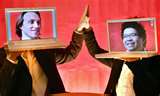
Those wild and crazy management figures at Yahoo continue to act according to the philosophy that "less is more." In this case, the once-proud Internet search firm sold the social bookmarking service Delicious to YouTube founders Chad Hurley and Steve Chen. The image (left) shows both Silicon Valley figures in a playful moment.

The pair intend to raise Delicious to "the next level," according to an AP story reprinted in the San Jose Mercury News. In the meantime, they'll fold Delicious into AVOS, "a new Internet company," according to the company's website. You don't say! At least we weren't misled into thinking AVOS was an acronym for a government-sponsored project, an offshore hedge fund, or an untested pharmaceutical product. "The next level" claim also spared us any sort of rigorous thinking. In fact, we could indulge ourselves on thinking about Delicious in any form we wanted. It feels better going down that way.