Showing posts with label Great Recession. Show all posts

Monday, September 2, 2013

US Economic "Recovery": A Tale of Two Workforces

It's fascinating to explore perceptions of the US economic situation. Many people assert the country has "recovered" from the financial disaster called the Great Recession. Things "are better now," is the common phrase. Major league insiders repeat this message via the media. Rather than believe their own eyes, some folks uncritically repeat what these hired corporate hands and their political allies disseminate.

Graph: motherjones.com
Living in the New York area, with its high concentration of one-percenters and those culling favor with that group, one could be convinced of the "recovery" by the drumbeat of supposedly good economic news, and signs (such as filled restaurants) suggesting a surfeit of disposable income. However, the shadow of the "others" who "did not participate in the recovery" lingers like muggers lurking in society's dimly lit streets. The dimensions and human qualities of the non-participants are inconvenient and largely ignored by those enjoying the continued, relentless, and ruthless wealth transfer from the have-somethings to the have-plentys.

A story in today's San Jose, California-based Mercury News discusses the phenomenon of the have-less, and focuses on issues "older workers" face. The bleak news, quietly tucked away on a low readership national holiday weekend, is sobering. The article summarizes its points as follows:

  • A recovery that for many older workers doesn't feel like one.
  • Two-thirds of baby boomers between ages 55 and 64 who found work after losing it in the recession are making less than they did in their previous jobs.
  • Their median salary loss is 18 percent, compared with a 6.7 drop for 20- to 24-year-olds.
  • The re-employment rate for this older age group is 47 percent, and 24 percent for those over 65, versus 62 percent for 20- to 24-year-olds.
  • Finding another job takes far longer, too: 46 weeks for boomers, compared to 20 weeks for young workers.
The Mercury News piece cites a recent report from the California Budget Project to deliver these unpleasant facts and conclusions. Economic "progress," the story notes
is complicated by a triple whammy of wage stagnation, a dramatic growth of low-wage jobs in hospitality and food services, and the staggering number of jobs lost in California during the recession -- 1.4 million, nearly half of which have yet to come back.
The California report could easily be repeated in nearly every other state in the Union. Does this sound like "progress" to you?

Wednesday, June 6, 2012

Who Profits From Denial of US Economic Situation?

For months, the drumbeat of "things are better now" has thumped through spokespeople who seem like a collection of "the usual suspects." If their shared perspective, so relentlessly driven in public statements and interview opportunities, were limited to the status of the very wealthy and record corporate profits, their case for the "better" could be plausibly presented. For most others, the Great Recession lingers like a form of chronic pain. That situation is ignored, unless political points are at issue.

Watching the Wisconsin election results on Fox News last night, I got the impression the only things holding our country back from a return to general prosperity were labor unions and Barack Obama. Fox's Neil Cavuto trotted out a number of CEOs who parroted this message, while not bothering to address why those interviewed were personally better off than ever.

David Rosenberg
(photo from Gluskin Sheff)
An outlook less chained to ideological imperatives, political expediency, and reality denial would provide far different information. One such individual is economist and financial strategist David Rosenberg. Once Merrill Lynch's respected voice on the economy, Rosie flew the US coop for Toronto. From this relatively sane perch at the Canadian financial firm Gluskin Sheff, he offers his opinions, which notably do not correspond to the propagandistic fiction available on your favorite American media outlet.

Zerohedge.com, an acerbic financial blog, has become something of a platform from which Rosenberg's perspective reaches money managers and amateurs with a strong interest in financial markets. Today's post featuring Rosenberg's point of view provides some deeply troubling information about the state of the US west of the Hudson River and north of 96th Street.

Here are a few salient points from the blog post:

  • "The share of long-term unemployment is at its highest level since the Great Depression (42%)"
  • "47% of Americans are on some form of government assistance"
  • "A mere 16% of the 2009-2011 graduating class has found full-time work, while 22% are working part-time. Even those hired from 2006-2008, only 23% are working full-time."
Do you think "things are better now"? What leads you to that conclusion?

Friday, October 7, 2011

Chinese Shadow Banking System Crisis, Post-Steve Jobs US Leadership Chasm Indicate Storms Ahead

Shadow banking systems don't like the light shining their way. When someone cares about the handshake deal market, it's generally a sign that trouble is brewing. That's why a recent Financial Times post about a storm developing in China's shadow banking world is worth noting.

Kate Mackenzie's piece essentially reports on a Societe Generale report on the fragile state of the real Chinese economy. Essentially, according to Soc Gen economist Wei Yao, it's in tough shape, torn between stunting credit growth to "unworthy" companies while continuing to lend to the stronger firms. The analogy used in Soc Gen's report was fish vs. dragons. The ancient Romans might have characterized the distinction as between Christians and lions.

Telephone Booth, 3 a.m. Rahway, NJ
Photo by George Tice
Why should we care about this report? The Chinese economy is largely viewed as a key driver to lift the developed world from either its ongoing or upcoming recession. The Soc Gen report effectively throws cold water on Chinese businesses running into phone booths and collectively emerging as an economic Superman. Any other suggestions for growth? Europe? Russia? India? Brazil? Mars?

Of course, the American mainstream media have either referred to recession in the past tense or the future perfect tense. Right now, everything in the US has returned to a sort of false financial grooviness. If you're prosperous and don't have to sweat tepid business growth realities, then, yeah baby, the recession was a passing headache. For most Americans, however, contemporary truth is grimmer. The number of Americans on food stamps is at an historically high level. Small businesses in the Land of the Free are largely excluded from the credit markets. The housing market, outside of a handful of desirable, insanely expensive areas, seems reminiscent of shipwreck survivors hopefully clinging to floating debris. The feeling is "things will get better, won't they?"

The bewilderment at the heart of this economic conundrum has produced something of a "deer in the headlights" feeling at high fiscal and political policy levels in the United States. Now that we understand China won't -- and can't -- ride to the rescue, the lack of ideas at the top becomes an even greater cause for profound concern.

David Packard (left) and Bill Hewlett
Well, an obvious "way out" of the predicament is for American firms to make products people around the world want. The most prominent example of this path is Apple. I think that's one reason why so many people felt an emotional sense of loss at Steve Jobs' passing. He created things people wanted. The buzz about Apple had always been "what happens after Jobs?" In a larger sense, who in Silicon Valley, or anywhere else, would be able to hold the torch of tech innovation after Jobs died?  This was an issue that mattered to Jobs, as Wired noted in a recent piece on Apple's former CEO. He particularly admired the sensibilities of Bill Hewlett and David Packard. Jobs regarded HP as the standard bearer for tech firms, their standards and their values; his tenure at HP unquestionably shaped Jobs' own keen interest in developing Apple's corporate culture.

No one really knows who will take the torch Jobs held and in many ways inherited from Hewlett and Packard. That feeling of uncertainty informs part of the post-Jobs tech world and the uniquely American sense of optimism it embodies. That uneasy sensibility underpins much of the sentiment expressed about Jobs in the aftermath of his passing.

The ascent of dogmatic American political ideology, the moral bankruptcy of US business leadership, a diminishing zeal for invention, and the rise in the nearly unquestioned belief that the achievement of "comfort" is the greatest possible good, are all symptoms of an America in decline. The coming financial storm in China will impact the United States, and leave America with few options to address its own crisis.

Fasten your seat belts: it's going to be a bumpy ride.

Sunday, February 13, 2011

Thain: Lehman Bailout Would Have Prevented TARP

The Bloomberg media empire, whatever its flaws, has performed some fine work exploring the 2008 bursting of America's financial boil. Its reporters have filed Freedom of Information Acts, the successful pursuit of which have brought to public light unsavory, discomfiting details about the financial markets and their interactions with federal agencies. Bloomberg's reporters have probed material gathered in testimony, gone to court, and basically done the dirty work that is the core of investigative journalism.

A case in point is today's simple story from Bloomberg reporter Hugh Son. In it, Son cites audio files released from the Financial Crisis Inquiry Commission focusing on comments submitted by John Thain.

Thain's thesis is that, had the Feds bailed out Lehman, the self-inflicted torpedoing of the American economy and subsequent (and largely misunderstood) TARP bailout would not have been necessary.

John who? How quickly we forget. Thain, currently CEO of CIT, was el primero at Merrill Lynch during the 2008 disaster. A former NYSE chairman, Thain stage managed the grafting of two wildly opposite enterprises -- Merrill and Bank of America -- into one splendid taxpayer subsidized catastrophe. He also had a hand in Merrill employees getting $4 billion in bonuses while the firm was plunging into the fiscal abyss. It has been strongly suspected, though unproven, that TARP funds paid for Merrill's way of saying goodbye.

For his part, Thain originally demanded a bonus for his role in the Merrill-BOA merger. He asked for $10 million in addition to his lavish compensation package. How lavish? In 1987, Thain earned around $83 million for his labors.

Thain, whose name rhymes with "vain," displayed an amazingly arrogant sense of entitlement throughout his career. The most egregious example of this behavior was his spending on his Merrill corporate suite. In early 2008, Thain had the firm pay over $1 million to redo two conference rooms, a reception area, and Thain's personal office. A $35,000 commode, part of the redecorating, was included in the deal. Only after those details became public information, and a source of outrage, did Thain reach into his pockets and pony up. (That leaves $82 million remaining from the 2007 compensation alone, in case you're keeping score at home.)

The former Merrill CEO still has powerful friends, as the linked relationship map from muckety.com suggests. He is a prominent Republican Party member and was among John McCain's economic advisors during the Arizona senator's unsuccessful run for the presidency. It's unknown whether Thain advocated for a continuation of the Bush tax breaks to the wealthiest 1% of Americans.

Saturday, December 4, 2010

A December to Remember?

The blog's title, borrowed from an automobile's company's annual year-end advertising campaign, made us wonder what would be so memorable about December 2010. Well, there's already enough to fill one's holiday stocking with episodes and incidents worth remembering. The following examples offer some ideas:

1. New Jersey's conservative, Republican governor Chris Christie has discovered YouTube is a very effective propaganda tool. This tactic became evident during a recent town hall meeting, in which a questioner was "escorted" to the stage by a state trooper. Then, in a physically bullying manner, the governor responded to the inquiry without allowing any sort of reply. A trooper removed the questioner and that was that: a perfect YouTube moment available for Governor Christie's fans. The Star-Ledger of New Jersey included the episode in its print coverage (no YouTube, sorry) of the town hall meeting.

2. In fairness, it should be noted Christie did confront a sacred cow of prosperous, typically Republican suburban communities at the town hall meeting. One of his questioners asserted his municipality's right to pay its school superintendent above the $175K cap the Christie Administration has decreed suitable for the position. The municipality used a line of reasoning which must have sounded familiar to its many highly compensated, Wall Street inhabitants: the proposed superintendent's salary was "competitive" with the local school system's perceived peers.

Senior management compensation committees and consultants have used the "peer" ploy to boost key personnel pay schemes for some time. The rationale is usually accepted without complaint, and the top dogs make a killing via compliant corporate boards. The superintendents and local boards of education know this game, and have shamelessly played it. Prosperous suburban communities have rarely hesitated to use financial incentives to land the candidates they want. As long as the school system stayed "highly rated," and the connection between a school system's quality and housing prices remained ironclad, the money would be found. While Governor Christie's politics and public personality are repellent, he's on the mark on this issue.

3. China v. Google -- The WikiLeaks material in The New York Times included some profoundly disturbing information regarding the Chinese government's relentless grip on its domestic information dissemination, its mistrust of Google as a tool of the American government (read the Le Monde summary of this episode for some of the juice), and the sinister efforts of elements within China to conduct cyberwarfare against United States interests. Keep in mind China holds trillions of dollars of United States government debt.

4. Google Settles "Street View"/Privacy Lawsuit for One Dollar -- A couple sued Google for its unwelcome photographing of their Pittsburgh area home. According to a story based on original reporting in the Pittsburgh Post-Gazette, Google employees drove 1,000 feet onto private property in order to get the photo of the couple's house. Google fought the lawsuit, only to eventually give in and pay a symbolic one dollar settlement fee. However, the couple had to pay their own legal fees. How many people have pockets deep enough, and time substantial enough, to fight Google? The FCC, meanwhile, is looking into allegations that Google's Street View campaign collected passwords and other personal information from unguarded WiFi locations. That information is quite significant in location-based marketing; the commercial leveraging of it by the aggregate information's possessor has the potential for a staggering financial bonanza.

5. Wild and crazy Mark Cuban made a fascinating post on Vator.tv called "The End of Location-Based Apps?" His thesis involves the increasing use of face-recognition software to identify prospects and customers in a specific location. He also makes a chilling assertion: "few people exclude their basic name and picture information from public search, so FB [Facebook] could be the first to provide a database of names and faces to the commercial world of facial recognition."

6. Zero Hedge posted a CNBC segment in which former Reagan Administration budget director David Stockman tells some very unpleasant truths about the American economy. Stockman notes how offshoring strongly and negatively impacted job creation in this country. (Liberals should take note this happened during the Clinton years as well as the Bush 43 nightmare. The corruption runs deep, my friends.) Stockman pointed out the inconvenient fact that most "new" jobs that have appeared during the Great Recession (Stockman's phrase) are mostly part-time jobs. He noted that government jobs will decline, as municipal and state governments are broke. And implicit in his observations is the time line for "recovery" is very, very long.

A December to remember? More likely, you'll want to take a rain check on this month. As Humphrey Bogart said in Casablanca, "I drink to forget."

Friday, November 12, 2010

The Cisco Kid That Isn't Kidding Anymore

Cisco Systems rocked the stock market yesterday, with a big miss on estimated earnings and an announcement that the coming quarters would basically suck.

Why is this a big deal?

Well, Cisco noted that public sector spending would not meet projections, and would not be robust for a long time. That bad news hits the core of the argument that "infrastructure" spending, laregely stimulated by government investment, would be strong, and would benefit firms such as Cisco.

Further, Cisco estimated that state and local tax revenues would not reach "pre-Lehman" levels for another five years. Ouch. That's one year after President Obama's presumed re-election. I emphasize the word "presumed."

The Bloomberg story, included in today's Washington Post, has the details.

Of course, the lurking story is the "recovery" from the Great Recession that no one except financial cheerleaders and those with a vested interest in boosting Manhattan real estate values has detected. Never mind how the cheerleaders haven't defined where the money will come from to pay for what's owed, and what's needed.

Friday, November 5, 2010

Record Number of Americans Apply for Food Stamps

According to a Department of Agriculture report, the number of Americans receiving food stamps has reached an all-time record. Over 42 million Americans, courtesy of government assistance, now get just enough to eat. Zero Hedge, the financial blog where I originally saw the notice of the Agriculture Department report, observed that the 42-million-plus roster represented a 17% increase from the same period in 2009. If you're keeping score, that's definitely not good news for the home team.

Do you still think the Great Recession is over?


Thursday, October 21, 2010

Will UK Budget Cut Wind Blow Across Atlantic?

Britain's Conservative government announced earlier this week its recommendation to cut nearly a half-million public service jobs from the current total. This 20% haircut has been characterized by Prime Minister David Cameron (seen at right) as necessary in order to address the UK's grim budget scenario.

The United Kingdom's American cousins will emulate this socially drastic script after the election bloodbath is over. The Republicans will want it, Democrats will not resist too strongly, and Obama already has his eyes on re-election. Likely targets will be postal workers, teachers, and municipal employees. The British, at least, will have brains enough to tax banks. The Americans will try the unique approach of giving the banks more money, especially once the foreclosure scandal reveals the tawdry state of major money center banks' balance sheets.

Do you still think the Great Recession is over?


Saturday, October 9, 2010

Sanofi-Aventis Says "Adieu" to 1,700 US Employees

French multinational "big pharma" firm Sanofi-Aventis announced yesterday that it would trim 1,700 jobs from its United States workforce. About 300 will be dropped from Sanofi's North American headquarters in Bridgewater, New Jersey.

Bridgewater is no backwater in the pharma world. Multinational pharmaceuticals and satellite firms are clustered near one another in central New Jersey, including Bridgewater. The firms want this arrangement, as it's easier to attract and keep its high-priced scientific talent, poach others from their competitors, and leverage the advantage of the region's roughly equidistant geographic position between New York and Philadelphia.

When the desirability of economic globalization gained traction some years ago, its advocates strongly asserted that the phenomenon would help the United States prosper. In particular, globalization's supporters (stand up, Clinton Democrats) pointed to "high-value" jobs in fields such as pharma as a strong reason to accept the "good" of globalization with the "bad". What a difference a few years make! Now, multinationals such as Sanofi-Aventis focus their efforts and their personnel in "high growth," cheaper labor regions of the globe, such as Asia south of China. The United States is not projected to experience either exciting growth or significantly cheaper labor costs for scientific talent.

Of course, if the Great Recession were truly finis, Sanofi's workforce trim would have been far less likely. The French firm has manifestly demonstrated, in deeds and not words, that the Great Recession has modified its economic expectations for America. Given the Gallic vote of little confidence in the USA's financial future, do you think those Sanofi jobs will return? Or that Apple, Amazon, and Google can single-handedly lift the American economy into a better place than it currently finds itself? Where will the money come from?

Wednesday, October 6, 2010

Food Stamp Usage Hits New High

According to The New York Times, the Great Recession is not only over, but ended many months ago. I suggest the editors get their heads out of their collective asses and look around at evidence to the contrary.

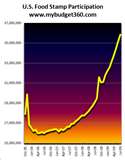
Here's Exhibit A: recent government statistics show about 1/8th of the entire United States population now receives federal government food stamps. That's right: one out of every eight people. That's a modern day record, as the sports announcers like to say.

This is not complicated evidence. It's freely available, and paid for with tax dollars. All one has to do to understand it is have an ability to read a simple chart and grasp a little bit of English. That might be asking too much of a newspaper that has the hubris to advertise it has the greatest reporters in the world and then have the chutzpah to add "there's no arguing that."

Meanwhile, one in eight Americans need government assistance to avoid starvation. There's no arguing that.

Wednesday, September 22, 2010

The Great Recession Observed by Wal-Mart CEO

A note from Art Cashin, director of floor operations at UBS Financial Services, was posted today in the financial blog Zero Hedge. Cashin's comments include the following observation from Wal-Mart's CEO:
"About 11 p.m. customers start to come in and shop, fill their grocery basket wth basic items -- baby formula, milk, bread, eggs -- and continue to shop and mill about the store until midnight when government electronic benefits cards get activated, and then the checkout starts and occurs. And our sales for those first few hours on the first of the month are substantially and significantly higher."
Based on the quote, and your own anecdotal evidence, do you think the Great Recession is over? All comments are welcome.

PS. The Dorothea Lange photograph above is titled "Dispossessed Arkansas farmers, Bakersfield, California," courtesy of the Library of Congress.