A few days ago, a photographer posted a landscape image on Facebook. One person commented that it was a shot a 12-year-old could have taken. (For the record, I believe the picture in question required considerable imagination and skill to envision and produce.)
The comment about the image reminded me of an episode shortly after I graduated from college. I was visiting someone who was far wiser to the ways of the fine art world than I was. In an attempt to show off my undergraduate knowledge, I spotted a Norman Rockwell work and made a snide observation about it. My host presented a different perspective. He pointed out Rockwell's ability as a draftsman and that one should respect skill, even in unfashionable works.
For decades, some visual artists have endured similar "a monkey could do it" potshots as the photographer experienced on her Facebook site. For artists to resist coarse opinion requires strength of purpose and a healthy self-regard. Unfortunately, the temptation to believe that unflattering commentary is limited to provincial show-offs does not correspond with the varieties of human nature. There are plenty of professional reviewers, for example, who cynically or thoughtlessly believe pithy smart remarks demonstrate wit worthy of Voltaire. It's fair to say some Philistines dress in all-black New York outfits, talk a good game, and are savagely ignorant.
Martin Scorsese once sagely observed about his own craft that the more he produced, the more he realized he didn't know. Scorsese learned to embrace exploration and learning, qualities not always highly valued in the movie business. Artists from all visual disciplines have independently arrived at the same conclusion.
Scorsese grasped how fleeting and precious the chances to expand one's intellectual horizons really are. When one compares accomplished creation to the level of a pre-teen's guesswork, a much greater opportunity for inquiry, for understanding, for enrichment, has been given the finger. That's sad. However, I have the consolation of returning to the photograph and appreciating its quiet confidence, observational skill, and simple beauty. I'm thankful for that.
Showing posts with label Photography. Show all posts
Showing posts with label Photography. Show all posts
Thursday, February 6, 2014


Monday, February 11, 2013
Atget and Friedlander -- The Princeton Exhibit
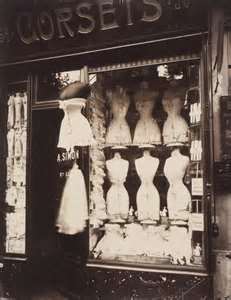 |
| Atget |
One delightful aspect of the exhibit is the museum itself, housed on Princeton University's campus. The uncrowded space allows for relaxed contemplation of the displayed works. Annoying devices providing podcasts or other recorded information are blissfully absent. The free admission removes the anxiety of "getting one's money's worth."
I'll let the Atget image and the Friedlander photograph, each of which appear in the Princeton exhibit, speak for themselves.
 |
| Lee Friedlander: New Orleans, 1969 copyright: Lee Friedlander |
Sunday, March 4, 2012
DC Photographer Ray Wilson, Now Blind, To Be Honored
 |
| Ray Wilson and his wife (photo from the Washington Post) |
The 76-year-old Wilson had to stop working as a photographer once blindness became a permanent condition for him. That has not diminished his zest for life, or his gratitude for achieving his photographic goals.
Sunday, October 16, 2011
Amy Becker's Photos at Hunterdon Art Museum


The show's official opening was today, and we attended in our best New York black outfits. Also worth noting is the statement from the show's juror, Trong G. Nguyen. His thoughtful statement thankfully avoided art world jargon.
I am interested, Nguyen wrote, in the completeness of an artwork. During the jurying process, and when I visit exhibitions in general, I ask myself
one simple question that initially determines whether an artwork will have the chance to resonate with me -- "Is this a complete work of art?" If I find myself at pause or unable to immediately answer this question then that answers a lot for me. However, if I find myself engaged and intrigued, with both my mind and eye, then this says something quite different....Works of art are inquiries into the curiosities of the artist, as well as a subsequent interrogation of these interests. While interrogation is routinely seen as a necessary tactic of law enforcement, in the realm of art the exhaustion of such a strategy is often sought and revered as insight into the mind of the working artist. Harsh interrogative techniques may be a form of extremity, but works that go out on a limb and make me question them usually earn my full respect.
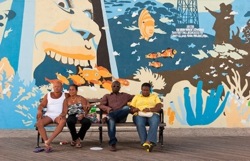
(From left to right: Tunnel Girl, Four on a Bench, Happy Hour.)


Sunday, September 25, 2011
"The Life and Death of Buildings" Photography Exhibit
 |
| Zhang Dali, Demolition, World Financial Center, Beijing. 1998 |
One aspect of the show I liked was how it offered credit to master printer Chuck Kelton. He's well known and appreciated in the photography world for his wonderful darkroom wizardry. Some of Danny Lyon's work at Princeton included Kelton's touch.
The museum's website provides an excellent overview of the show, links to some of the photographers, and links to "related" work from artists not included in the exhibit proper.
If you live in the New York-Philadelphia axis, "The Life and Death of Buildings" is definitely worth the trip. (The show closes on November 6th.) Best of all, the museum, including its exquisite collection of antique art and Asian art, is free.
Monday, July 4, 2011
Detroit Chases "The Young, The Entrepreneurial, and The Hip"
 When Clint Eastwood's Gran Torino was released in 2008, I suggested to my wife that Detroit was ripe for an influx of cultural players. The feeling was more of an intuition than a reasoned argument. I didn't have any empirical data, think-tank white papers, or information about new, prestigious targeted funding initiatives beyond what film production companies were receiving from the state of Michigan. There was almost nothing in the national zeitgeist to lead one to conclude Detroit was anything but on a civic death watch. When federal politicians, presidential wannabes, or media talkers discussed Detroit, they often used references to the good old days (the auto empire at its apex), the worse old days (the 1968 riots), and the city's current, ominous financial situation as a cautionary tale for post-Lehman America. There was some discussion of white flight, the history of Detroit's African-American community, the automobile unions, and the disintegration of Detroit's business core. That discussion became inconvenient once Detroit became an easy icon for America's current domestic crisis.
Value investors assert that the best time to consider new investments is when the assets in question have been talked down to a low level relative to their actual worth. Detroit fit this profile quite neatly. The city was simply too politically and economically connected to national power structures. Its geographic position and well-developed transportation links gave it useful market access. And, while Michigan has unquestionably declined in economic terms, one had a sense that a bottom had been reached. The state still had a well-educated population that would now be willing to work for lower salaries than in the past. The state government was willing to provide "entrepreneurs" seed money and other financial incentives to locate in Michigan and especially Detroit.
This set the stage for Detroit to consider welcoming cultural pioneers to selected neighborhoods. The civic gambit is a simple formula invoked with almost ritualistic belief. In essence, the notion is to encourage those involved in the arts, software development, and satellite industries such as fashion, to move into distressed neighborhoods. They would form the vanguard of neighborhood transformation. Once they secure an area, presumably restaurants and other middle-class attractions would join the fun. If the formula holds (I have experienced this in New York), land values and rents increase, more prosperous people move in, and a "recovery" is duly celebrated.
With that history in mind, I read a recent, prominently played New York Times piece on Detroit's efforts with more than casual interest. The paper was pretty shameless about its positioning of the piece. It ended up in the "Fashion & Style" section. The article clearly took dead aim at the 21-35-year-old readership for which the Times lusts. The writer made the stakes clear: Detroit was after the "young, the entrepreneurial, and the hip." (So is the Times.) A caption in the lead photograph asserted "An influx of young creative types in turning Detroit into a Midwestern TriBeCa." The caption had almost no connection to what was in the photograph, except for one essential element: both subjects in the photo were young Caucasian men. There they were: the "new" Detroit.
The article made quite deliberate reference to other "cultural" cities, such as Seattle and 21st Century Berlin. The story implied Detroit would follow a similar path to cultural glory as did rainy Seattle and the German capital. Whether Detroit would succeed is another matter. I hope it does, but I don't trust naked civic boosterism from a nationally important media platform.
One indirect benefit of the Times story is that it raised my interest in the African-American singer Monica Blaire. (She is quoted in the Times article.) I explored her music and enjoyed much,though not all, of what I heard. Her music has a contemporary, soulful sound, and I like that. Ironically, Blaire's musical style connects her to Detroit's African-American musical heritage, something the "young, the entrepreneurial, and the hip" (to quote the Times piece) have little organic relation to.
The photo (top) is titled Downtown Detroit. Image credit: Yves Marchand and Romain Meffre, from the "Ruins of Detroit" 2010 exhibits and book of the same title.
Monday, May 30, 2011
Decoration Day
 In our time, Memorial Day has two purposes: to acknowledge the sacrifice of men and women in the armed forces and to serve as the unofficial launch of the summer season. Previous eras in American history took a more solemn view of the day's significance. The day was a holiday by decree, rather than a "natural" holiday such as New Year's Day. It began in the post-Civil War era, and was called Decoration Day. While the day's name gradually shifted over the following decades to Memorial Day, it retained its hold on May 30th as the celebratory date.
In 1971, federal legislation called the "Uniform Holidays Bill" shifted Memorial Day to fit into the demands of a three-day holiday weekend. Some, including veterans groups, feel this date change has diminished the holiday's resonance with a population that coincidentally has largely done its best to avoid military service.
Many still retain a strong feeling for Memorial Day. Flagman, an image taken by my wife, the photographer Amy Becker, that suggests the depth of this sentiment. The man in the photograph found the flags left on the street after a parade. He took them home, washed the flags, and displayed them.

If you enjoy post-war blues, Sonny Boy Williamson's Decoration Day is a way to go, although the harmonica player's conflicts were more domestic than nationalistic.
Sunday, May 15, 2011
Frederic Chaubin's Photographs of 1980s Soviet Architecture
 A blog item in today's online edition of the LA Times discussed a book of French photographer Frederic Chaubin's images of 1980s architecture in former Soviet Union republics. One has to see them to believe them. If architecture intends to interpret and manage social imperatives, these structures leaves one puzzled. It's tempting to simply assign "visions of the future" to these edifices and call it a day. I don't think that's the case, as these buildings and monuments were clearly intended for immediate use and contemplation.
It is definitely worth one's time to view the available images from online links. A very good one is avaiable from the ZKM/Museum fur Neue Kunst, a Karlsruhe, Germany institution that had a 2011 exhibit of Chaubin's work. The link includes an engaging, four-minute video of Chaubin discussing his work. Another interesting interview with Chaubin is provided by the now-defunct, Japan-based website PingMag.
While Chaubin's book is a new release, his project is not exactly fresh. The images have taken something of a world tour for at least the past four years. In 2007, The New York Times reviewed a Gotham gallery's show of these photographs. Chaubin's personal website is unfortunately currently under construction.
The Chaubin image in this blog shows The Central Research and Design Institute for Robotics and Technical Cybernetics in St. Petersburg, Russia.
PS. Apologies to those who are literate in French and/or German. I've left out the diacritical marks in certain words, as I'm not confident the Google software can successfully handle them. Anyone who can offer a solution is welcome to post it here.
Saturday, November 13, 2010
Prix Pictet
 The Prix Pictet, a high-profile environmental photography award, has released its list of qualifying images. The pictures, and useful explanatory background information, is available via the Asian edition of the Financial Times.
The photographers are hardly strangers in the art world night. Taryn Simon is represented by Gagosian; her image shown here is taken from her appearance on Charlie Rose. Edward Burtynsky's work was the focus of Manufactured Landscapes, an excellent movie about the environmental degradation of China that my wife and I saw at Film Forum in New York. Thomas Struth "studied under Gerhard Richter," according to the FT information.
The Prix Pictet winner will be announced in March 2011.
Friday, October 22, 2010
Annie Leibovitz
 Today's Financial Times includes a very interesting, and rather long, piece on Annie Leibovitz.
 The article skillfully leverages reporting about the photographer's financial and personal issues into an examination of the art world. The article does explore Leibovitz's entirely earned reputation as a diva and as an asshole. (Not mentioned in the piece are the vendors, the "small people," Leibovitz routinely stiffed.) Had the article stopped with the petty gossip about the photographer, the piece would not have been a strong one. Instead, the writer wisely and thoughtfully portrayed why Leibovitz's travails and difficulties were met with the art world's silent, but well-known nod of approval.
Curiously, the article asserts Leibovitz's prints do not generate large selling prices. It was astonishing to read that her prints are worth far less than $10,000, while other "name" photographers easily earn ten times that amount for a print.
Of course, a British newspaper broke the story. The New York-based art media has too much at stake to touch the Leibovitz story, especially her embarrassing near-bankruptcy and the unflattering perspective on her personality. It's true The New York Times ran a worthwhile story around the time Leibovitz was sued by a creditor. It's also the only time the newspaper has done so in Leibovitz's career.
However, Leibovitz has discovered a hard lesson about life in New York: it's one thing to be fashionable, but it's another to be respected.
Wednesday, September 15, 2010
The Great Depression in Color
 Roger Nusbaum, in his respected personal finance blog Random Roger, did a very unlikely, yet entirely admirable thing in comments he posted today on his site. He discussed color photographs taken during the later years of the Great Depression in the United States. He also included a link to a Denver Post blog that shows the images.
The pictures originally appeared in a 2006 Library of Congress exhibit called "Bound for Glory: America in Color." My favorite so far (shown above) is #18, Russell Lee's "saying grace before the barbeque dinner at the New Mexico Fair." The principal subjects possess an uncalculated modesty, while remaining rooted in their worldly concerns. The secondary subjects inhabit the frame, but appear to be independent of the major figures. Lee's willingness to have multiple, barely joined subjects in the frame seems surprisingly tangent to contemporary visual sensibilities.
I hope you take a few minutes to enjoy these explorations in color photography.
Monday, July 26, 2010
Freedom of Photography

Today's Washington Post included a story addressing the rights of individuals to photograph public buildings and public venues. While the article focuses on the District, the issues are applicable to other American cities and towns.
My wife, in her fine art photographic ventures, occasionally encounters someone who tells her she can't take a picture of a public place. It's a live issue for her, and by extension, for anyone who is concerned about photographic freedom.
Monday, June 14, 2010
Reflections on My Wife's Studio Tour
My wife Amy was part of our town's artist studio tour yesterday. Her participation meant the first floor of our apartment was turned into a venue for a one-person exhibit. She didn't accomplish this venture alone: Donna Compton generously spent hours organizing the images and giving Amy's opus its conceptual logic and presentation oomph.
I thought I knew the images well. I've been present for the shooting of nearly all of the nearly seventy hung pictures (hey, find your own link for off-color jokes!) and nearly as many photographs contained in bins. Over the years, Amy and I have discussed the images. I've understood her thinking as she modified them in a darkroom or via Photoshop. We've discussed further directions her photographs might go. Yet, their unique magic almost -- almost -- seems hopelessly elusive to me.
Sometimes, I know what she saw the moment she snapped the picture. That's a very satisfying feeling. However, more often than not, Amy saw something that required her innate talent to grasp, and grasp immediately, without reflection or calculation. When I look at them now, I don't know how she did it, even though I was a witness and intimately aware of my wife's thinking. For someone who cares about the person, the artist, the photograph, this puzzling feeling leaves one wondering how much one can truly understand about any person, and about the act of creation itself.
Subscribe to:
Posts (Atom)


