Showing posts with label University of Wisconsin-Madison. Show all posts

Monday, October 14, 2013

Report: It's Raining Diamonds on Saturn

(Image: news.nationalgeographic.com)
The diamond occupies a central place in the diadem of gemological history. The recognition of the stones' value began in India over 3,000 years ago. Today, these precious jewels continue to maintain a sort of hypnotic spell for possessors as well as for those who covet their neighbors' goods.

Part of diamonds' allure is its scarcity. That's not the case elsewhere in the solar system. According to an unpublished paper recently presented by a University of Wisconsin (UW) scientist, it's literally raining diamonds on Saturn and Jupiter. UW scientist Dr. Kevin Baines co-wrote the paper with private sector expert Mona Delitsky; the BBC carried the story of their findings.

A diamond rainstorm sounds implausible, and some scientists are skeptical about the paper's assertions. Baines and Delitsky counter by noting Saturn's and Jupiter's atmospheric conditions and likely chemical composition offers ideal conditions for diamond formation. However, the stones don't survive; they eventually plunge into the planets' unimaginably hot inner layers, possibly forming a pool of liquid carbon.

I suppose that's a fitting end to a diamond rainstorm: attractive to imagine, but impossible to possess.

Friday, March 22, 2013

Chinua Achebe -- RIP

Chinua Achebe, the Nigerian writer best known for his pathfinding novel Things Fall Apart, died this week at age 82. The obit in the online edition of the BBC provides a useful overview of his literary output, political activities, and global impact.

Chinua Achebe (left) with Nelson Mandela
(photo: BBC)
Achebe's work is often found in high school curricula in the United States. That was not the case for me. I first encountered Achebe's prose when I was a raw freshman at the University of Wisconsin. At that time, I thoughtlessly registered for a class in African literature. That mindless choice turned out to be one of the best intellectual encounters I experienced in any academic setting. The professor, Harold Scheub, was a very adept collector of oral stories. He walked -- yes, walked -- through South Africa, recording storytellers speaking what I discovered was the very beautiful Xhosa language. He accomplished this feat during the height of apartheid -- a tall order for a Caucasian carrying a tape recorder and a backpack. He also showed slides (those were the days!) of South African landscapes that entirely projected the country's marvelous physical setting. The professor, through the works he explored, opened my eyes to a world of thinking. His imagination and rigor changed my intellectual development in profound, beneficial ways.

Cover of First UK Edition
The class consisted of quite a number of purposeful graduate students, a few undergrads who had an affinity or compelling academic interest in the subject, and me. In addition to a thick course packet and a fascinating collection of African folktales, the required reading list for the semester included fourteen novels. One of them was Things Fall Apart. I had never heard of it prior to that class. I enjoyed the book, but its larger lessons were lost on me at the time. However, over the years, I kept seeing Achebe's masterpiece around and eventually understood its significance in world literature.

Achebe's life and work stand as potent reminders of how "engaged" writers impact our world. One may encounter a book by accident, as I did with Things Fall Apart, but continue to be touched decades later by its tone, its perspective, its characters, its message, its mysterious magic.

Sunday, October 21, 2012

Game Day

A glimpse of a Big Ten Game Day crowd. This shows the 10 am scene
at State Street Brats in Madison, Wisconsin.

Saturday, February 18, 2012

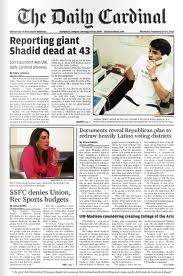
University of Wisconsin-Madison Journalism Grads Recall UW Grad Anthony Shadid

Anthony Shadid, the Pulitzer Prize-winning journalist who recently died in Syria, began his journalism career at the University of Wisconsin-Madison's student newspaper, the Daily Cardinal. Some journalists spawned at the Cardinal recently spoke with a Milwaukee Journal-Sentinel reporter about Shadid's influence and friendship. The reminiscences are reminders about how one person can impact peers and friends in ways that can't be measured in bits and bytes.

I can't pretend to have followed Shadid's writing or issues. We attended UW-Madison nearly a generation apart. His Daily Cardinal, and the one where I worked as a UW undergrad, were almost certainly different creatures. However, the paper was and remains a great place -- in my opinion, the best in the United States -- to learn the x's and o's of journalism. Shadid's body of work honors the Daily Cardinal's proud, enduring legacy.

Sunday, January 1, 2012

Academia's Star Professors and Their Corporate Connections: One Case Study

It's fascinating to watch college football during the holidays, but watching under-21s play without pay bothers me. The bowl games are a financial bonanza for universities, though they like to downplay that notion. Meanwhile, lots of "scholar athletes" play for free, while the U "monetizes" their gratis labor. It's scandalous that the players don't get paid, while the schools rake in the cash.

A 1930s photo showing a vaudeville-band act
serenading cows at the UW-Madison's Dairy Barn, in a scientific test
to determine whether soothing music would produce more milk.
(Photo from Wisconsin Historical Society.)
This observation connects to a larger theme, namely that American universities never really come clean about why education is outrageously expensive. These days, the cost to weave through the academic obstacle courses known as undergraduate and master's degree programs can reach a quarter of a million dollars. Parents of students, and students themselves, are told that the outrageously high cost of higher education just can't be helped. Meanwhile, universities raise tuition rates at double the nation's inflation rate, without even condescending to answer the question of sound fiscal management.

Sometimes, universities point to their salary structure and shrug their collective shoulders. What schools don't like to publicly air is that academia's top stars' and insiders' generous compensation packages are just the tjp of each school's "dream team's" financial bottom line. "Name" faculty members attract significant contracts for "research" or other tangible contributions to enterprises or big-time grant funding.

Dr. Thomas Zdeblick
A case in point recently emerged at my alma mater, the University of Wisconsin-Madison. According to an article in the Milwaukee Journal-Sentinel, the school's Chairman of the Department of Orthopedics and Rehabilitation, Thomas Zdeblick, M.D., earned more than one million dollars in university compensation in 2010. But that's peanuts compared to the $25 million Dr. Zdeblick has earned in royalties since 2003 from the medical equipment firm Medtronic. Dr. Zdeblick, one of the nation's leading spinal surgeons, created a back surgery product called Infuse that Medtronic manufactures and sells.

As the Journal-Sentinel article noted, major league academic department chairs and paydays from pharmaceutical firms and medical device makers is hardly unusual. While ethical issues were noted in the article, the money is what stands out. I'm entirely in favor of inventors making money from their creations.  However, when a university hides behind "inflation" and sticks it to parents and students to pay so that academic stars are compensated to enrich themselves, that's a problem.

I doubt academic mandarins have any desire to resolve this issue. Why would they give up such a lucrative deal? In my view, parents and students have to rise up against this system and compel it to come clean. It's something to consider while you're watching unpaid "scholar athletes" compete in this year's corporate-sponsored bowl games.

Tuesday, December 20, 2011

Academic Study Claims Link Between College Football and Male Grades


Academic researchers, who never admit to wasting time or money, will study just about anything. That includes the relationship between college football and academic performance. Recently, according to an Associated Press story picked up by the San Jose Mercury News, a trio of University of Oregon economists conducted a study to explore the impact of a football team's impact on grade point averages. The study indeed found a correlation between a winning football season and a decline in male student grade point averages.

One curious aspect of the report is its authors' interest in the subject. How did three members of the dismal science find this subject germane to their field? Why did they care? Who on earth paid for findings that are reminiscent of a "moderately corrupt" police chief discovering gambling in Rick's Cafe?

In fairness, the "Oregon Three" professors touched some live wires. For starters, the study noted the differential between female student performance and that of their male counterparts. Yes, women are smarter. But you knew that already. Didn't you?

Phil Knight
The study's setting is also a very curious one. The University of Oregon's football team is a big-time operation, including "contributions" from alum Phil Knight and his firm, Nike. If money talks on campus, Knight's cash is shouting.

Meanwhile, the profs' research findings implied lousy football teams tended to keep male students more attentive to course work, presumably including economics. My own experience with collegiate football is contrary to those findings. During my four years at the University of Wisconsin, the Badger football team either stunk or had, at best, occasional flashes of eptitude. The team's fortunes did not in any way improve my attention toward my studies. In fact, the year I attended the greatest number of football games (and the team wasn't anything special that season), I garnered very good grades.

It's true I was among the rowdy at a football game for five autumn Saturdays that year. Those were exciting, formative life experiences I would never, ever trade for the equivalent time in a library. Sometimes, academics just don't get it.

PS. Ironically, the Badgers will play the Oregon Ducks in the Rose Bowl in January. I'll be watching -- on TV.


Sunday, September 11, 2011

September 11, 2001 -- Ten Years Later


I was working in New York on September 11, 2001. Here are some thoughts about that day and its echoes:

Around noon ten years ago, I was trying to get out of New York and get home. Both World Trade Center towers had collapsed, bridges and tunnels to the mainland were closed, the sense of "there's more" was in the air. Thankfully, I was able to communicate with my wife using e-mail and, then, private messages via an Applchat chat room. She suggested immediately going to an ATM and withdrawing funds. That was sage advice; I might have needed the cash to bribe my way out of town, obtain food and/or water, find shelter.

I thought my one chance to get across the Hudson River was by ferry. The mainland ferries were not well known at that time, although I was familiar with them, as I always made it a point to know every possible transportation angle in and out of the City. I walked over to the ferry slips on the West Side. They were crowded, but there was a chance to make it across. I took that chance, and in the late afternoon boarded what turned out to be the last ferry to Hoboken.

The boat's route ventured within a mile of the smoldering Trade Center site. No intervening buildings blocked the view. Everyone onboard became quiet. We were close, very close, to the heart of darkness.

Once the ferry docked, passengers were separated by those who had been south of Canal Street and those who had not. Those who had been south of Canal were washed down from head to toe; their clothes were not replaced. They went on their journey wet.

Amazingly, I got on a train and went home. (Hoboken was a mainland railroad terminal and was consequently not shut down during the 9/11 incident.) The ride went by in a kind of daze. I did observe four office workers helping one of their colleagues, who was in shock, get home.
Given her condition, the afflicted woman could never have gotten home on her own.

My wife met me at a railroad station near our home and I finally felt a sense of relief. Before we drove away, I bought a six-pack of beer and a large bag of potato chips. I consumed four bottles that evening and did not feel buzzed or anything.

In the days and months following the 9/11 incident, I continued to work in the City. I kept enough cash in my pocket to allow for "contingencies." I completely avoided any underground subway or railway, except to briefly cross the Hudson River. (I take them now.) I took the bus from the West Village to the Columbus Circle area where my office was located. I walked whenever possible. Sometimes, I would go a little out of my way to the now-closed St. Vincent's Hospital, which was Ground Zero's front-line hospital, and look at the pictures on "Missing" flyers affixed to the outside walls and nearby streetlight posts. I avoided the Morgan postal annex, the West Side site of the post-9/11 anthrax episode that was so disturbingly mishandled by federal security and health agencies.

The 9/11 incident was not my first time living in cities where politically motivated murder had taken place. I was in Rome when Italian prime minister Aldo Moro was kidnapped and ultimately killed. (For an Italian perspective on the Moro case, read the excellent writer Leonardo Sciascia's book The Moro Affair.) A year later in Rome, an extreme right-wing group blew up a nightclub for ostensibly political reasons. Earlier in my life, I was a student at the University of Wisconsin in the aftermath of a left-wing group's bombing of a building housing armed forces research projects; a researcher was killed in the incident. My student newspaper, of which I was a staff member, was a highly interested party in the articulation of the group's point of view and later, in legal defense for one of its members.

The 9/11 incident was nothing like the Rome or Madison situations. 9/11's purpose combined nihilism with fanaticism in ways the Roman or Wisconsin participants never imagined. Whatever one feels about 9/11's perpetrators, their common denominator was a willingness to use mass murder to achieve their aims. For the perps, if the achievement of their goals included the end of the world, their attitude was "so be it."

Recently, I was talking with someone who had fled a war zone created by religious animosity. As it turned out, his once peaceful backwater had erupted into hateful violence. He noted that there was no reasoning once the conflict had started, and, at the time, no obvious path toward ending the conflagration existed between religiously-charged communities. Once war began, he said, you never knew where or how it would end, or what would change. The one thing you could count on was nothing would be the same.

He could have made the same observation about New York, and the United States, in the post-9/11 era.

The photo shows "Missing" flyers posted outside St. Vincent's Hospital in the days immediately following the September 11, 2001 incident.

Wednesday, August 10, 2011

Patrick McGilligan's New Bio of Director Nicholas Ray

Pat McGilligan, the rare film historian who prefers living in America's interior to either coast, has just published a biography of director Nicholas Ray. He discusses his new book -- Nicholas Ray: The Glorious Failure of an American Director -- in an interview in the Milwaukee Journal-Sentinel.

McGilligan, with whom I was acquainted during our undergraduate years at the University of Wisconsin-Madison, does his work the old-fashioned way. He really interviews subjects, does plenty of documentary due diligence, and takes a professional approach to his writing. Some of his books, such as his George Cukor biography, are significant contributions to film histories written in English. My personal favorite is Backstory, a five-volume series McGilligan edited and, in some cases, wrote. The books feature intelligently conducted interviews with screenwriters who discuss their experiences in the movie business over many decades. The interviews' length, depth, and respectful treatment of its subjects are in marked contrast to the harried Q&A film journalism that clutters many contemporary magazines and newspapers. They also offer a useful window into how movie projects became finished films. In that way, the interviews provide a dose of reality about a business resolutely involved with illusion.

Nicholas Ray's body of work, and his controversial personal life, make the stuff of a great tale. My guess is that Pat McGilligan relates the director's story well, and the book would be a stimulating, enjoyable book to read. You should check it out.


Saturday, March 26, 2011

Exploring Militant GOP Tactics In Wisconsin/New York Times "Cronon Affair"

William Cronon (right), a University of Wisconsin-Madison professor, has become something of a cause celebre in American media and political circles. An Op-Ed piece he recently wrote for The New York Times discussed the recent political events in Wisconsin involving its governor, legislature, public service unions, and collective bargaining. Cronon explored the efforts of political conservatives both within the Badger State and outside Wisconsin to cut the unions down to size and, ultimately, eliminate them. An entry in Cronon's blog goes into considerable, thoughtful detail about the conservative movement, its influential institutions, powerful backers, and formidable discipline. He includes links to websites of various right-wing organizations, and demonstrates a seriousness of purpose that gives his opinion a desirable sense of gravitas.

The appearance of Cronon's Op-Ed piece, combined with his web links to information about the conservative movement, led to a curious development. The deputy executive director of the Wisconsin GOP requested, under the state's strict open records laws, e-mail from Cronon's state e-mail account. As UW-Madison is a state school, Cronon's e-mail account is subject to an open records request. The university has taken the matter under consideration, with one eye toward academic freedom.

At first glance, it would seem the GOP tried to swat a fly with a baseball bat. However, this line of reasoning would assume Cronon is the target of the Republican effort. He's too small a fry for this highly visible style of action. Something else is in play here.

Since the 2010 mid-term elections, the Republican Party and its conservative networks have schemed to aggressively advance their political agenda in Congress and in state legislatures. The nation, in effect, has become a laboratory for political tactics. Various states are made to order for this sort of experimentation. The union-busting activity began in New Jersey; its success emboldened the GOP to go on an anti-union offensive in the Midwest.

Scott Walker, the newly-elected Wisconsin governor, serves a useful purpose for the Right. He is not running for national office (unlike Indiana's Republican governor). His state can be sacrificed in the 2012 presidential election for the "greater party good." He has majority votes in both houses of the legislature to make his proposals politically unstoppable.

Walker's legislative actions and the protest movement against them offered tremendous opportunities to test the conservative movement's most extreme forms of legal and possibly illegal actions. In a small state, tactics could be refined that would contribute toward a larger, strategic prize. In that sense, Wisconsin 2011 resembles the Spain of 1936, with Walker playing the role of Francisco Franco. It is in this context that the GOP's move against Professor Cronon and The New York Times makes best sense.

The right-wing's play in the Cronon affair is to intimidate those who would cooperate with The New York Times. This e-mail fishing expedition, like a Mafia warning, is designed to deliver a message. All forms of harassment are considered fair game in this exercise. And what can be done in Wisconsin can be done, with some modifications to local conditions, in other states. The Times took it seriously enough to have a Sulzberger write an article about the most recent wrinkle in the Cronon situation.

According to the Milwaukee Journal-Sentinel's article about the GOP e-mail request, any e-mail with "references to any of the following terms" need to be released:
"Republican, Scott Walker, recall, collective bargaining, AFSCME, WEAC, rally, union, Alberta Darling, Randy Hopper, Dan Kapanke, Rob Cowles, Scott Fitzgerald, Sheila Harsdorg, Luther Olsen, Glenn Grothman, Mary Lazich, Jeff Fitzgerald, Marty Beil, or Mary Bell."

Most of the names, the Journal-Sentinel article continues, are Republican senators. Marty Beil is the head of the Wisconsin State Employees Union and Mary Bell is the head of the Wisconsin Education Association Council.

Will the right-wing find any dirt that will appear on its propaganda vehicles? Maybe. That's not as important as chilling relatively open communication, freedom of thought, and implying pro-union linkage between individuals or institutions. Does that atmosphere feel familiar? If you're thinking the bad old days of the Bush-Cheney secret police state, with all the ugly implications of blackmail and extortion connected to it, you're on the right track.

I doubt the GOP cares about Cronon; the Grand Old Party cares a great deal about the Times and its national reach. When one eliminates sources, gathering and reporting news becomes far more challenging. It also becomes far easier to present "fair and balanced" reporting which reflects right-wing ideological assertions, as opposing voices become muted or distorted.

Resisting intimidation is not an easy matter. No amount of politically liberal bravado will change that psychological reality. However, to successfully resist first means understanding one's adversary. Professor Cronon attempted to provide pathways to that useful goal. He deserves our gratitude for his actions, and for his opposition to Mafia-style, right-wing strongarm tactics.

Saturday, January 1, 2011

Wisconsin and the Rose Bowl


I'm getting ready to watch the 97th Rose Bowl football game, which features the University of Wisconsin playing Texas Christian University. I'm a Wisconsin alum, so I have a vested interest in the game and its outcome.

The Rose Bowl still has magic for me. As an athletic and, by extension, fan goal, the game has an almost magnetic pull. Its tradition, including the Tournament of Roses Parade (the elephant float captures the parade's mood), retains an allure no other college bowl can match. The setting, as both Wisconsin and TCU coaches noted this week in an LA Times story, can be mesmerizing. Players never forget performing in front of 100,000 fans and a national TV audience. The Rose Bowl is big time; only Notre Dame, when they're good, can deliver the same impact. (It's one reason why college football is better off when ND has a strong squad.)

In contrast, the so-called "national championship" and other BCS games seem invented events designed to generate income, pacify influential sports commentators, and satisfy incorrigible university boosters.

This is the fourth Rose Bowl for Wisconsin since I completed my undergraduate studies there. I still own a Badger red sweatshirt with a discrete, one-rose "Wisconsin -- 1994 Rose Bowl Champions" logo on it. I'll have bratwurst ready for this afternoon's action. (Sorry, no beer today.) I still feel the pull of Pasadena setting, the romantic sundown, the excitement and glamor of the great game. As a fan, I worry, because TCU is fast, favored, and unknown to me.

The Rose Bowl has a more subliminal meaning as well. It symbolizes a sense of completion and success, of a journey from charming farmland to enchanted gardens, from being bundled up to enjoying swimsuit sensuality. The feeling is a powerful one. It is enhanced by televised Rose Bowl games, which present snow covered mountains, gleaming skies, and people looking happy and comfortable. Californians I know somewhat resent the Rose Bowl for that image, which they consider misleading and the generator of delusional transplants to the region.

I've had personal experience with both sides of that proposition. I appreciate the practical value of the "sensible" perspective. However, only a sourpuss would categorically reject the Rose Bowl's opportunity for brief enchantment. It's as if one should stop dreaming, having glorious ambitions, or thinking big. It's like trying to deny the American urge to go "out West" (versus "back East"), or to stop the tides once one reaches the Pacific. The Rose Bowl's great message is that one is better off running for the roses, rather than running away from them.

Go Badgers!

Friday, October 15, 2010

Camp Randall

Tomorrow night, Ohio State will play Wisconsin at the Badgers' home field, Camp Randall Stadium. I went to UW football games when I attended the university. The games were very rowdy, a lot of fun, and sometimes freezing cold in the stands. At that time, Wisconsin's football teams were around .500. The highlight of the season was when a Big Ten powerhouse came to town. That meant either Ohio State or Michigan.

While I never saw a Michigan game, I did catch the Buckeyes. Woody Hayes, in the twlight of his career, was the coach. When one attends a sports event in person, one quickly notices the size of players. The difference in perception between live action and television is most noticeable in nuances such as relative sizes of the athletes. Ohio State's players were far bigger than anything Wisconsin had on the field. They were also faster, but it was the size differential that was very, very striking.

At the end of the game, I was very upset that State had won. We were seated within a stone's throw of the area where the Ohio State team exited the field. I took the "throw" part to heart, picked up an object, and was about ready to throw it at Hayes himself. Fortunately, a friend (Charlie, for those who know the people in the story) kept his head and prevented me from what would have been an act of certain folly, likely severe injury, and probable arrest. He scolded me and told me I was crazy to even contemplate such an act.

He was right, of course.

I know better now. And I remain a fan. I still root for the Badgers. I work with someone whose daughter attends Ohio State. We didn't bet on the game, but we know where we stand. One of us will be happier than the other on Monday.

Thursday, September 9, 2010

Marching Bands

Football games and parades have one thing in common: marching bands. At their best, marching bands can rouse a crowd, lift one's heart, help one feel life's rhythms and pulse. I attended the University of Wisconsin, and its band reflected the student body's perspective that having fun was an "all in" experience.

The bands at historically African-American colleges and universities tend to hold my attention. They offer a fabulous sense of physical and musical rhythm that's wonderful to watch and hear. I was reminded of this while watching the pre-game segments of tonight's pro football game in New Orleans. The home team's band was from Southern University. The band played "When the Saints Come Marching In" and it sounded and looked right.

Do you have a favorite marching band? You're welcome to share your preferences in the comments box.

Sunday, August 1, 2010

Laissez-Faire Education in a Parochial School

One powerful current in the American social experiment is to shift education from a public school model to one in which public funding will support parentally-driven "school choice." Included among the choices are parochial schools, whose principal mission is to inculcate religious values into those attending their institutions.

I attended parochial schools from kindergarten through high school. During the time I attended those schools, teachers and administrators had wide lattitude to say or do just about anything. This laissez-faire educational approach was especially true in high school.

My experience in that environment was a deeply negative one. Some instructors were inept, or had barely enough qualification to transmit useful subject information. One instructor, who I thankfully did not have, directed his geometry class to make paper birds for three months; they did not do anything else, such as connect the project to geometric principles. Other instructors' grasp of pedagogy was not always apparent, though not as egregious as the bird brain teacher's wackiness.

Another instructor had a history of mental illness, including injuring a stud
ent during a class by slamming his head into a blackboard. The teacher was allowed to continue his profession in the same school, after taking a well-timed leave of absence. The high school guidance counselor did not demonstrate the slightest grasp of expertise in psychology, and once publicly described a student to the pupil's peers as "a bum." The counselor's only known gift was an ability to shoehorn seniors with borderline academic credentials into local Catholic colleges.

School assemblies included speeches from staff members in support of right-wing politics and political beliefs. These were not open forums, where contrasting views could be explored. School attire was jacket and tie, which we were told would "prepare (you) for the business world." This approach struck me as opposed to the encouragement and development of open inquiry, the use of which is the sign of a strong, independent mind.

At the time, the high school's main calling card was athletic achievement. In fairness, I'll point out that the coaches were highly qualified and helped get college scholarships for otherwise nothing-special student-athletes. The basketball coach was connected to the New York basketball mafia, with college and pro contacts cramming his address book. The track coach eventually became an athletic director at a Jesuit university, which seemed fitting.

Both coaches possessed a very strong sense of self-assurance and a willingness to impose their will on their student minions or just about anyone else they could push around. They were not interested in inquiry and discovery as much as "measurable achievement," demonstrated in fast sprint times or points per game. However, I respected their competency, although I loathed their methods.

I could not say the same for the teaching staff, with a couple of exceptions. But, by golly, there was discipline of a sort. For me, that part of the experience was pointless, since it was not grounded in my heart and was unpersuasively taught.

Clearly, the parochial high school was not the right fit for me. I chose to attend a public university -- The University of Wisconsin-Madison.
After much wandering in the wilderness of classes catering to a 30,000-plus student body, I began to develop the emotional wherewithal, the love of curiosity, and the willingness to embrace risk, that was never part of the educational package in the parochial high school I attended.

It is my contention that parochial schools are philosophically and practically unable to present such a package to today's students. Whatever the problems of public schools are, parochial schools are not the answer.


Thursday, July 8, 2010

Bob and Gene's


A friend recently sent me a Facebook link about Bob & Gene's, a now-vanished bar in Madison, Wisconsin. If you attended UW-Madison, I think you will agree the Facebook link's photographs present an accurate depiction of the bar. My wife saw the photos and affectionately characterized Bob & Gene's as "a dive."

I never thought of Bob & Gene's in that way. I knew people who went there, the beer was inexpensive, and the atmosphere appealed to me. The conversations were pretty earthy and often a lot of fun; the highbrow talk was consigned to a bar across the street that served "schooners" of beer.

I've only consumed green beer on St. Patrick's Day once in my life, and that was at Bob & Gene's. The green stuff was godawful, and I've avoided bars on St. Patrick's Day ever since that episode.