Showing posts with label US financial crisis. Show all posts

Monday, June 15, 2015

Goldman and AIG: A Tale of Two Tales

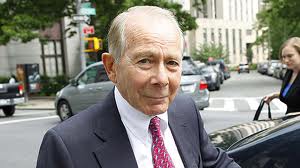
Hank Greenberg
The New York Times, in a display of wicked irony, today published in its online edition two stories connected at more than the hip. The articles, placed adjacent to one another on the paper's splash page. concerned Goldman Sachs and A.I.G. At one point during the day, a third feature, focusing on former A.I.G.'s chairman Hank Greenberg's nemesis, Eliot Spitzer, joined the twosome. Well, someone at the Times certainly had a sense of humor.

In 2008, A.I.G. and its house of subprime loans collapsed. The Federal Reserve essentially seized the firm. Bernanke's minions arranged for Goldman Sachs and a select few other Wall Street institutions to receive one hundred percent on the dollar for its A.I.G. debt. Let's just say that action is highly unusual in a de facto bankruptcy process. Hank Greenberg, who knows the inside game perhaps better than anyone, was "upset."

The former Army Ranger took his umbrage to court, suing the government for what Greenberg perceived as unfair treatment of his former firm. The case was considered a long shot. However, a federal judge today ruled in favor of Greenberg's suit.

Andrew Ross Sorkin
(Image: marketwatch.com)
The Times' lead financial dog, Andrew Ross Sorkin, expressed something close to disbelief in the judicial decision. He also got others to assert on the record that the judgment would create chaos the next time too-big-to-fail....um....fails. In fairness, Sorkin has a subtle understanding of the complex events of the 2008 crash. However, Greenberg happened to be right about the looting of A.I.G. for Goldman Sachs' (and other institutions') benefit.

One wonders what Greenberg thought when he saw today's Times story about Goldman. The Wall Street firm intends to get into the online, retail loan business. Yes, small-time loans would be a new profit center for the Masters of the Universe. In the event of default, guess who gets one-hundred percent on the dollar. Again.

Sunday, January 27, 2013

Iceland President: "Why Do We Consider Banks To Be Like Holy Churches?"

Icelandic President Grigsson
(photo: http://www.forseti.is/)
In all the financial media's hoopla over the high-profile, big-think, but little-action event known as the World Economic Forum in Davos, Switzerland, one breath of fresh air emerged. That came courtesy of Iceland's president Olafur Ragnar Grimsson, whose nation painfully experienced fiscal disasters similar to those Lehman Brothers symbolized in the United States.

Grimson asks -- and answers -- not-so-rhetorical questions such as why banks are considered capitalism's sacred cows, too big to fail, too powerful to scrutinize, and too arrogant to question. The financial blog zerohedge.com posted on Grimsson's remarks. The post includes a video clip of the complete, three-minute interview of Grimsson.

The Icelandic president's comments and his line of reasoning are absolutely spot on. It's ironic his remarks came during the victory lap of one Timothy Geithner. The now former US Treasury secretary worked overtime to ensure America's largest financial institutions felt as little pain as possible for their acts of corporate folly. Instead, taxpayers were offered a poisoned chalice masquerading as a "solution" to the prospect of a second Great Depression.

Hank Greenberg
Former AIG chairman Hank Greenberg's disingenuous lawsuit against the Federal government approaches the chalice from an insider's perspective. In essence, Greenberg claimed the Federal actions, which essentially took over AIG, were designed to funnel money from the insurance company to major Wall Street institutions. Geithner played a very strong role in this situation, which included paying Goldman Sachs and other firms one hundred percent on the dollar for certain AIG instruments they held. What's unusual about that arrangement is that firms typically take a haircut on these fire sales. Greenberg asserted these actions were really a back-door bailout of Wall Street's "too big to fail" holy churches.

The corruption, which is at the heart of these issues, runs very deep. The excellent financial writer Bethany McLean notes that directions, such as jailing bankers, quickly enter deep waters that defy 
simplistic answers to these issues. One area which would impact the corruption, in her view, is to hit the bankers where they feel it -- their compensation. That approach, along with Icelandic president Grimsson's views, are useful starting points in what promises to be a long, difficult fight against very entrenched, powerful constituencies.

Tuesday, February 21, 2012

US Debt to GDP ratio passes 100%

In a dispiriting sign of the times, today marks the date when US government debt passed American GDP.  The story, noted in the financial blog Zero Hedge, includes a graph on the sovereign entities buying our nation's debt (hint: it's not the People's Republic of China.)

It is incredible to think that the United States now sells more more federal debt instruments than economic production can cover. What's more disturbing is that there is no sign whatsoever that this grim trend will slow down, flatten, or reverse its slope. The train will keep on rolling, until it becomes a train wreck.

Fannie Mae's Washington, DC headquarters
In a related story, the Washington Post noted details about a federal agency's plan to scale back Fannie Mae and Freddie Mac. This development, treated as a ho-hum article, was literally unthinkable a decade ago, even by the most ardent GOP congressman. Now, the twin housing behemoths are symbols of the housing disaster, a calamity whose ripples Americans are just starting to really feel. Yet this home-grown financial Pearl Harbor, more than any other episode during the disastrous first decade of the 21st Century, has shamefully brought our country to its knees.

Of course, if you count purchases of cell phones, tablets, and drones, we're doing just great.

Saturday, January 14, 2012

Former SEC Official Fined For Taking Job With Alleged Ponzi Fraudster Robert Allen Stanford

Robert Allen Stanford (right) celebrating a victory
his cricket team -- the Stanford Superstars -- won
(photo from The New York Times)
The new millenium has largely been a fiscal disaster of epic proportions for the United States. One example of how corruption seized the country's major financial and governmental institutions is the Robert Allen Stanford saga.

A little fresher about "Sir Robert" is in order. Stanford, a dual citizen or Antigua/Barbuda and the United States, was raised and made his initial big stake in Texas, starting with the Houston real estate market. He later moved to the Caribbean, where he opened financial firms under the cozy terms existing in Montserrat and, later, Antigua. He parlayed the firm's products into a bonanza. The Antiguan government was grateful enough to Stanford to award him a knighthood. Shortly after the end of fellow Texan George W. Bush's tenure in the White House, the SEC and FBI discovered gambling was occurring in Sir Robert's casino. In essence, the SEC accused Stanford of operating a Ponzi scheme. The FBI arrested the knighted financier. Stanford has pleaded not guilty to the SEC's accusations. Meanwhile, his defense team, including court-appointed attorneys, are in tumult, according to a post in the Texas Lawyer publication's Tex Parte Blog.

Sir Robert's trial is scheduled to begin January 23rd. In the meantime, the SEC has fined one of its own for taking a job with Stanford. The former SEC official, Spencer C. Barasch, was the head of enforcement in the SEC's Fort Worth, Texas regional office. During his tenure, Barasch squashed three separate probes into Stanford's enterprises. In 2005, Barasch left government employ and eventually wanted to get his share of the Stanford gravy train. To that end, Bararsch offered his services to represent Stanford Financial Group in yet another SEC probe of Sir Robert's activities.


For this ethical lapse, Barasch agreed to settle for a fifty grand fine, while his attorney continued to claim with a straight face that Barasch was entirely innocent.

Such misunderstandings of ethics remain with us as we struggle through the profound, systemic corruption in America, and financial "wizards" such as Stanford, Bernie Madoff, and a gaggle of former Fannie Mae and Freddie Mac senior executives increasingly resemble Caribbean pirates rather than knights in shining armor.

Tuesday, January 10, 2012

Hon Hai's Terry Gou Bracing For Recession "Worse Than 2008-2009"

Terry Gou
The Taiwanese firm Hon Hai plays a key role in the manufacturing of Apple products, Dell laptops, and Sony TV. The enterprise is a 71% owner of Foxconn, which has been accused of creating inhumane labor conditions in its factories in the People's Republic of China. Recently, Hon Hai's chairman, Terry Gou, expressed a decidedly pessimistic take on global economic prospects. According to a story in the Financial Times, Gou said "the only certainty is that there will be a (global) recession, of a scale I have never seen since I entered business."

When someone with insight into the manufacturing volumes and needs of the world's hottest tech products speaks, it's worth considering what has been expressed. And what Gou said is very grim news indeed, coming on the heels of Europe's economic troubles and a still very uncertain United States. One shock, one black swan event, could send the whole house down again, 2008 style.


Sunday, November 13, 2011

David Rosenberg Remains Realistically Gloomy on the Economy

David Rosenberg
David Rosenberg was Merrill Lynch's chief financial guru when the bull wasn't full of shit. He was generally considered a wise, sharp mind who didn't shave the truth to suit some corporate profit goal. Rosie, as he's affectionately known in financial circles, fled to his native Canada shortly after Bank of America acquired ML.

Rosenberg joined Gluskin Sheff and Associates, a Toronto-based finance firm, and continued to call 'em as he saw 'em. Rosie, as he's known among his peers, did not drink the post-Lehman Kool-Aid. He thought -- and thinks -- the US and the overall global economy are struggling mightily. He also believes they will continue to struggle for some time. His pessimism certainly has not settled well with the financial tom-tom beaters, who have tried to con retail investors and a very edgy voting public that "things were better" and that "the recession had ended over a year ago."

Rosie keeps calling Wall Street's publicity bluff. In his most recent newsletter to clients (and a recent interview with Consuelo Mack), Rosenberg talks about how the US economy is the midst of a depression. He defines his terms, brings useful evidence to bolster his points, and states his case plainly. While the news is not cheerful, it is refreshing to read economic analysis that's free of cant and that trusts the truth.

The financial blog Zerohedge.com generally publishes Rosenberg's comments. He's also an occasional guest on Bloomberg Surveillance, its excellent morning radio program. Rosie's thoughts are worth reading, worth listening to, and definitely worth thinking about.

Tuesday, October 18, 2011

Spike in Number of Californians Entering Foreclosure

Every time the toms-toms are beaten to declare that the US economy is wonderful again, an unwelcome guest appears. This week's entrant comes from the Golden State. According to an LA Times report, the number of Californians receiving a notice of default -- the first step in the foreclosure process -- increased roughly 25% over the previous quarter. That's not good news, as filings had reached a three-year low earlier this year.

Beyond the percentages, the actual number of foreclosures is daunting. Over 70,000 notices were sent out to delinquent mortgage holders in the past three months. Some home owners have more than one mortgage, which would suggest they are profoundly underwater.

At some point, the country (not only politicians) will have to wake up and smell this unpleasant brand of coffee. The US economy, with the housing market at its core, cannot advance until the foreclosure catastrophe is honestly faced. That event has not yet happened, and few have possessed the will to address the housing disaster in a sensible way. It's a financial time bomb that keeps on ticking.

Friday, October 7, 2011

Chinese Shadow Banking System Crisis, Post-Steve Jobs US Leadership Chasm Indicate Storms Ahead

Shadow banking systems don't like the light shining their way. When someone cares about the handshake deal market, it's generally a sign that trouble is brewing. That's why a recent Financial Times post about a storm developing in China's shadow banking world is worth noting.

Kate Mackenzie's piece essentially reports on a Societe Generale report on the fragile state of the real Chinese economy. Essentially, according to Soc Gen economist Wei Yao, it's in tough shape, torn between stunting credit growth to "unworthy" companies while continuing to lend to the stronger firms. The analogy used in Soc Gen's report was fish vs. dragons. The ancient Romans might have characterized the distinction as between Christians and lions.

Telephone Booth, 3 a.m. Rahway, NJ
Photo by George Tice
Why should we care about this report? The Chinese economy is largely viewed as a key driver to lift the developed world from either its ongoing or upcoming recession. The Soc Gen report effectively throws cold water on Chinese businesses running into phone booths and collectively emerging as an economic Superman. Any other suggestions for growth? Europe? Russia? India? Brazil? Mars?

Of course, the American mainstream media have either referred to recession in the past tense or the future perfect tense. Right now, everything in the US has returned to a sort of false financial grooviness. If you're prosperous and don't have to sweat tepid business growth realities, then, yeah baby, the recession was a passing headache. For most Americans, however, contemporary truth is grimmer. The number of Americans on food stamps is at an historically high level. Small businesses in the Land of the Free are largely excluded from the credit markets. The housing market, outside of a handful of desirable, insanely expensive areas, seems reminiscent of shipwreck survivors hopefully clinging to floating debris. The feeling is "things will get better, won't they?"

The bewilderment at the heart of this economic conundrum has produced something of a "deer in the headlights" feeling at high fiscal and political policy levels in the United States. Now that we understand China won't -- and can't -- ride to the rescue, the lack of ideas at the top becomes an even greater cause for profound concern.

David Packard (left) and Bill Hewlett
Well, an obvious "way out" of the predicament is for American firms to make products people around the world want. The most prominent example of this path is Apple. I think that's one reason why so many people felt an emotional sense of loss at Steve Jobs' passing. He created things people wanted. The buzz about Apple had always been "what happens after Jobs?" In a larger sense, who in Silicon Valley, or anywhere else, would be able to hold the torch of tech innovation after Jobs died?  This was an issue that mattered to Jobs, as Wired noted in a recent piece on Apple's former CEO. He particularly admired the sensibilities of Bill Hewlett and David Packard. Jobs regarded HP as the standard bearer for tech firms, their standards and their values; his tenure at HP unquestionably shaped Jobs' own keen interest in developing Apple's corporate culture.

No one really knows who will take the torch Jobs held and in many ways inherited from Hewlett and Packard. That feeling of uncertainty informs part of the post-Jobs tech world and the uniquely American sense of optimism it embodies. That uneasy sensibility underpins much of the sentiment expressed about Jobs in the aftermath of his passing.

The ascent of dogmatic American political ideology, the moral bankruptcy of US business leadership, a diminishing zeal for invention, and the rise in the nearly unquestioned belief that the achievement of "comfort" is the greatest possible good, are all symptoms of an America in decline. The coming financial storm in China will impact the United States, and leave America with few options to address its own crisis.

Fasten your seat belts: it's going to be a bumpy ride.