Thursday, June 18, 2015

YouTube Launches Newswire Team to Curate Eyewitness Footage of News

Google's YouTube has, for better or worse, become a significant, primary news source. The ability of a person-in-the-street to provide in-the-moment video and post it on YouTube has changed information dissemination. For TV networks, the emergence of YouTube and its Newswire project would suggest a greater migration of eyeballs to the online world.

The fly in this ointment is its rawness. How could one trust the veracity of an amateur video? It's not as if an outsider video provider had any institutional connection that would bring ballast to the "must-see" moment. Well, to solve that issue, the folks at YouTube have announced the formation of "YouTube Newswire." This team's role will be the curation of the day's hot news videos. According to a story in theverge.com, the Google group will partner with Storyful, a social news outfit whose primary mission will be to vett the video content.

As Google itself pointed out, over five million hours of video are watched on YouTube every day. Not all of them are cute doggies, charming babies, and celebrity baloney. There's hard news. However, as Google knows, trust is a big world in the social media universe. The YouTube Newswire alliance with Storyful seems a small price to pay to maintain that trust.


Tuesday, June 16, 2015

US Airlines Play the Slots at NYC Area Airports

Newark Liberty Airport
(Image: panynj.org)
Remember a time when airlines competed against one another? Those days are increasingly becoming a chapter in commercial aviation history. The major US carriers -- United, American, Delta, Southwest -- are apparently pursuing a business strategy predicated on local dominance rather than robust competition. A case in point is Newark Liberty Airport, the closest New York area airport to my residence. United currently commands about seventy percent of the facility's arrivals and departures. That fact gives the airline considerable leverage in its consumer pricing. In contrast, United's LaGuardia-based service is typically cheaper than its Newark-based flights to the same destination. A lot cheaper, as I discovered (and used to my advantage) during my frequent flyer days.

Access and passenger-unfriendly pricing is hardly limited to New York. Hubs such as Atlanta foster de facto monopoly service and high rates. How can this business situation exist? Airport access is entirely controlled by the number of slots an airline can obtain. This tends to be a fixed number. According to a recent Bloomberg article, these slots are the currency between airlines that aim to obtain quasi-exclusive control of lucrative local markets. The recent Newark-JFK slot swap engineered by United and Delta is a case in point. Why the FAA permits these anti-competitive situations to fester is an interesting question.

Image: en.wikipedia.org
One suspects the United States is marching toward acceptance of the notion of controlled aviation markets, high prices, and effectively no competition. These three qualities precisely characterized the friendly skies prior to industry deregulation. One big difference between flight during the Mad Men epoch and today's House of Cards era is service. At least in a deregulated world, you didn't have to pay for a pillow, a blanket, or a meal. Then again, a traveler couldn't gamble on an airplane. Contemporary passengers can simply go online and play the slots.

Good luck beating the house, whether it's Las Vegas action or slot-fixed airline fares.


Monday, June 15, 2015

Goldman and AIG: A Tale of Two Tales

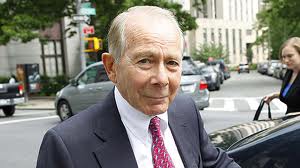
Hank Greenberg
The New York Times, in a display of wicked irony, today published in its online edition two stories connected at more than the hip. The articles, placed adjacent to one another on the paper's splash page. concerned Goldman Sachs and A.I.G. At one point during the day, a third feature, focusing on former A.I.G.'s chairman Hank Greenberg's nemesis, Eliot Spitzer, joined the twosome. Well, someone at the Times certainly had a sense of humor.

In 2008, A.I.G. and its house of subprime loans collapsed. The Federal Reserve essentially seized the firm. Bernanke's minions arranged for Goldman Sachs and a select few other Wall Street institutions to receive one hundred percent on the dollar for its A.I.G. debt. Let's just say that action is highly unusual in a de facto bankruptcy process. Hank Greenberg, who knows the inside game perhaps better than anyone, was "upset."

The former Army Ranger took his umbrage to court, suing the government for what Greenberg perceived as unfair treatment of his former firm. The case was considered a long shot. However, a federal judge today ruled in favor of Greenberg's suit.

Andrew Ross Sorkin
(Image: marketwatch.com)
The Times' lead financial dog, Andrew Ross Sorkin, expressed something close to disbelief in the judicial decision. He also got others to assert on the record that the judgment would create chaos the next time too-big-to-fail....um....fails. In fairness, Sorkin has a subtle understanding of the complex events of the 2008 crash. However, Greenberg happened to be right about the looting of A.I.G. for Goldman Sachs' (and other institutions') benefit.

One wonders what Greenberg thought when he saw today's Times story about Goldman. The Wall Street firm intends to get into the online, retail loan business. Yes, small-time loans would be a new profit center for the Masters of the Universe. In the event of default, guess who gets one-hundred percent on the dollar. Again.

Sunday, June 14, 2015

Whisky: My Single Malt vs. Blended Journey

On a humid June Sunday evening, in a sober state of mind, I decided to read a BBC travel piece about Scotch. The article didn't drive me to drink, but it did remind me of my adult journey into the misty world of whisky -- not whiskey -- appreciation. Apparently, the Scots call their famous adult beverage "whisky." That's not how I was raised. My dad, who wasn't much of a brown spirits man, called the strong stuff "Scotch." He also claimed it was a Wall Street favorite, with the implication that the drink found its natural audience among hard-headed bankers. It wasn't the people's choice among my crowd, which had just obtained the right to vote. If my friends and acquaintances had held an election for the leading juice, they would have stuffed the ballot box for vodka.

View of Lagavulin
(Image: islay.org.uk)
Well, times and tastes change. A couple of presidential elections later, my Scotch appreciation ratio substantially changed through the influence of a teacher where I worked. She had lived a rather worldly life in Scotland and developed a perspective on whisky's hierarchy of quality. During one of her trips to the UK, I asked her to bring me back a bottle of "something good." I had a brand in mind, but she suggested Lagavulin. I went along with the recommendation of the voice of experience.

Peat mound
(Image: islay.org.uk)
Some weeks later, she presented me with a bottle of smoky bliss. She also insisted I consume the whisky "neat," which I did. The beverage, prepared over peat fires, communicated the character of Islay, the island of the drink's manufacture. I've made it a point to have some Lagavulin on occasion. Many years ago, my wife purchased on sale some Baccarat highball glasses for me. They work nicely with Islay's gift to whisky.

Until two years ago, I entirely focused on consuming single malt Scotch. However, I've made one concession to financial common sense, in that I order a blended whisky as a dinner cocktail. A dear friend talked me into it. She found the blends easier to drink and that's what mattered to her. I conceded the point. It also helped me economize on my whisky purchases, as blends are much cheaper than single malts.

I suppose the world of Scotch whisky drinkers will always be divided between those who prefer blends or those who demand their favorite single malts. (The nearly religious differences over individual single malts is a discussion in itself.) My theory is a simple one: I enjoy both styles and drink both types. And I've yet to have a conversation with a Wall Street banker over a glass of whisky, but I suspect that day will come.

Saturday, June 6, 2015

Yahoo To Fold Its Maps Page

Yahoo billboard in San Francisco,
removed in 2011.
In a telling sign of the times, Yahoo will shut its maps page at the end of June 2015. The news, initially released via a Yahoo blog post, was reported by AP and reposted in siliconvalley.com.

Yahoo's strategic rationale is its focus on generating advertising revenue. One can suppose that Yahoo Maps just didn't have enough ROI to justify continuing the service. The unspoken reason is that Google Maps profoundly benefits from the Mountain View company's search dominance. Yahoo and former Google exec Marissa Mayer knows that unpleasant rationale as well as any Yahooligan.

Marissa Mayer
(Image: wikipedia.com)
She has made a public show of moving Yahoo into "more profitable" areas, with the recent NFL deal providing Exhibit A. That's fine, but Yahoo's larger problem, which Mayer has not solved, is its inability to dominate any business category. Google owns search and video (thank you, YouTube); Amazon commands e-commerce; Facebook has corralled the friends and family networks; Apple has a private and highly lucrative mobile-savvy customer base.

Yahoo has its merits, starting with its excellent Finance site that manages to be useful for the retail investor as well as some pros. However, one gets the sense that Yahoo is increasingly bringing up the rear, with little innovation, not much pizzaz, and declining interest. I admit to some sentimentality regarding Yahoo. I've used the service for years and can recall its golden years. Those times, of course, are long gone, but the brand still resonates for me. Its allure, though, is diminishing. That's bad news for any brand, but especially one for which "ahead of the curve" is both the essence of its value proposition and its survival mantra.

Thursday, June 4, 2015

Hillary Backs Age 18 Universal Voter Registration

Hillary Clinton
with former Secretary of Defense Robert Gates
observing the North Korean border
During a speech today, Hillary Clinton advocated for nationwide universal voter registration for all citizens who reach age 18. The comments, as reported in the Los Angeles Times, had two purposes. One of them was to increase the number of eligible voters, a seemingly laudable goal. Hillary's other goal was to criticize Republican presidential candidates whose actions have effectively trimmed voter rosters in their respective states. The GOP plan is predicated on uncomplicated electoral math in which racial minorities and young voters are systematically blocked from their voting franchise. Often, the right-wing uses the absurd them of "voter fraud" to achieve its cynical purpose.

The GOP should be -- but isn't -- ashamed of itself for perpetrating this offense. If the Republican programs were so popular, the party of the elephants would not have to resort to discouraging or suppressing voters from expressing their opinion. Once upon a time, the GOP could count on white male voters to carry national elections. (This was a premise of the 2012 Romney campaign.) Well, we know how that one worked out, although the Democratic Party had to fight Republican voter suppression efforts in states such as Pennsylvania.

The notion of universal voter registration makes sense. The "state's rights" crowd is almost certain to fight any such proposal. They want to take "their" country back. So do 18-year-old voters.

Tuesday, June 2, 2015

Actor Wendell Pierce (The Wire, Treme) To Pen NOLA Book

Wendell Pierce (middle)
in a scene from Treme
(Image: hbo.com)
Wendell Pierce first caught my attention during his years playing worldly, cynical Baltimore police detective in The Wire. The 48-year-old actor later appeared as a musician in Treme, an HBO series about post-Katrina NOLA. Pierce's ambitions range beyond the small screen or even the second screen. His newest venture is authorship of a book about his hometown, Hurricane Katrina's physical and psychological impact on the Crescent City, and his own family's storm-driven odyssey.

According to Dianna Dilworth's piece in Galley Cat, Pierce's book's title is Hurricane Katrina in the Wind in the Reeds (sic): A Storm, A Play, and the City That Would Not Be Broken. Meanwhile, Pierce will star in a New Orleans stage production of Brothers From the Bottom, a play concerning post-Katrina issues that continue to roil the cradle of American jazz.

Monday, June 1, 2015

Report: Costco Now Biggest Organic Grocer, Not Whole Foods

If you were taking odds on which grocer sold the most organic goods, Whole Foods would seem like the smart money bet. You would also lose your money. According to financial analysts cited in a Seattle Times article, Costco's organic sales are outpacing "Whole Paycheck's." The story behind the news shows up deep in the article: "The U.S. Department of Agriculture (USDA) says that demand for organic foodstuffs is growing at double-digit rates."

Sunday, May 31, 2015

Fed Reserve Report: Some States' Policies Accelerating Personal Income Divide

Domestic concern over America's widening personal income gap has gotten the Federal Reserve Bank's attention. A recent Fed research report, according to a Washington Post story, details states whose tax policies effectively increase the wealth gap between the have-a-lots, the have-somethings, and the have-nots. Regressive tax regimes typically form the heart of levies that hammer the poor and working classes. The dwindling middle class is now discovering the potency of regressive tax schemes (i.e., everyone pays equally, such as gasoline taxes).

The right-wing won't have an easy reply for these findings. GOP presidential candidates, for example, can't smear the Federal Reserve as a tool of class warfare and retain a shred of their credibility. As the draconian GOP regime Kansas has demonstrated, the Republican mantra of "tax cuts" leaves the civic body fiscally bankrupt and its citizens morally shamed. What the Republican Party doesn't really want to talk about is its implicit embrace of a two-class society, although Mitt Romney came close to articulating this position during his 2012 presidential campaign. The common sense reality is that those on the bottom will pay for the luxuries enjoyed by the top, through regressive taxes and give-to-the-rich tax cuts. That scenario sounds more akin to a banana republic than a confident democracy.