Saturday, October 9, 2010

Sanofi-Aventis Says "Adieu" to 1,700 US Employees

French multinational "big pharma" firm Sanofi-Aventis announced yesterday that it would trim 1,700 jobs from its United States workforce. About 300 will be dropped from Sanofi's North American headquarters in Bridgewater, New Jersey.

Bridgewater is no backwater in the pharma world. Multinational pharmaceuticals and satellite firms are clustered near one another in central New Jersey, including Bridgewater. The firms want this arrangement, as it's easier to attract and keep its high-priced scientific talent, poach others from their competitors, and leverage the advantage of the region's roughly equidistant geographic position between New York and Philadelphia.

When the desirability of economic globalization gained traction some years ago, its advocates strongly asserted that the phenomenon would help the United States prosper. In particular, globalization's supporters (stand up, Clinton Democrats) pointed to "high-value" jobs in fields such as pharma as a strong reason to accept the "good" of globalization with the "bad". What a difference a few years make! Now, multinationals such as Sanofi-Aventis focus their efforts and their personnel in "high growth," cheaper labor regions of the globe, such as Asia south of China. The United States is not projected to experience either exciting growth or significantly cheaper labor costs for scientific talent.

Of course, if the Great Recession were truly finis, Sanofi's workforce trim would have been far less likely. The French firm has manifestly demonstrated, in deeds and not words, that the Great Recession has modified its economic expectations for America. Given the Gallic vote of little confidence in the USA's financial future, do you think those Sanofi jobs will return? Or that Apple, Amazon, and Google can single-handedly lift the American economy into a better place than it currently finds itself? Where will the money come from?

Friday, October 8, 2010

Playoff Baseball

I saw a few innings of the Philadelphia-Cincinnati baseball playoff game on television this evening. The game had some very exciting moments, including hit batsmen, defensive gaffes, and poised play. It also featured new faces to the playoff show, such as Cincinnati star Joey Votto and Philadelphia's extraordinary pitcher Roy Halladay.

Baseball desperately needed new, dynamic blood into its big time showcases. Fans across the country will now get to see underappreciated talents such as Texas' Michael Young and rising stars such as the Giants' Tim Lincecum. They're thriving, even though they play far from Yankee Stadium or Fenway Park.

For a time, television networks assumed on our behalf that the only truly desirable baseball "products" were the Yankees and Red Sox. During the post-season, solid teams such as the Minnesota Twins, lost in the shadows of major market franchises, get their moment in the bright lights. I admit I root for the Yankees, but I enjoy how baseball's new generation of great players make a playoff baseball game something to savor.

Thursday, October 7, 2010

Cultural Revolution Stamp Collection

Earlier this evening, I watched Mao's Last Dancer, a film based on the autobiography of the Chinese ballet dancer Li Cunxin. The movie includes a sequence in which the dancer performs for Jiang Qing, Mao Zedong's wife and leader of the Gang of Four during China's Cultural Revolution. In a few minutes, the movie successfully recalls how oppressive, dangerous, and deluded China's leadership was during that dark period.

When I taught English in New York's Chinatown many years ago, I met students who had experienced the Cultural Revolution. It is difficult for us to grasp the swirl of revolutionary hysteria that gripped China at that time. The historical episode touched every Chinese. I don't take such incidents lightly, and occasionally reflect on how something similar could happen elsewhere.

One of my Chinese students showed me her stamp collection featuring pristine stamps from the Cultural Revolution. Heroic farmers, dedicated leaders, strident slogans graced those
functional objects, transforming them into aggressive political icons. The student knew the stamps were more than simply collector's items. They reflected history, one that directly,negatively impacted her family.

To this day, I recall the stamps' lurid power, and hoped I would never have to encounter such collective insanity as the student's family did over four decades ago.

Finally, the Nobel committee's award of the Nobel Peace Prize to Chinese dissident Liu Xiabo is an unintended, yet entirely suitable coda to this post. The Chinese government's reaction to the honor, which it characterized as an "obscenity," baldly demonstrates why people of thought are persistently troubled the country's current, rigid political direction and have profound intellectual and moral doubts about its future.

Wednesday, October 6, 2010

Food Stamp Usage Hits New High

According to The New York Times, the Great Recession is not only over, but ended many months ago. I suggest the editors get their heads out of their collective asses and look around at evidence to the contrary.

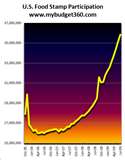
Here's Exhibit A: recent government statistics show about 1/8th of the entire United States population now receives federal government food stamps. That's right: one out of every eight people. That's a modern day record, as the sports announcers like to say.

This is not complicated evidence. It's freely available, and paid for with tax dollars. All one has to do to understand it is have an ability to read a simple chart and grasp a little bit of English. That might be asking too much of a newspaper that has the hubris to advertise it has the greatest reporters in the world and then have the chutzpah to add "there's no arguing that."

Meanwhile, one in eight Americans need government assistance to avoid starvation. There's no arguing that.

Tuesday, October 5, 2010

Rogue Traders


A French court passed sentence today on so-called rogue trader Jerome Kerviel, whose unauthorized trades supposedly put the august French financial institution Societe Generale (Soc Gen) in jeopardy of financial collapse. The former trader was convicted of forgery, breach of trust, and unauthorized use of computer systems. He received a prison sentence and a fine of nearly five billion Euros. That's right -- billion.

The sentence, the fine, the accusation should be considered in light of Soc Gen's reputation as masterful derivative traders, skilled risk takers, and core members of the French power structure. It is extremely unlikely that an institution with a disposition toward firm control, such as Soc Gen, would have let a rogue trader run wild for a couple of years. When things were good for Soc Gen and its rogue, the bank made billions from his trades. When events challenged Soc Gen's business, Kerviel became a convenient fall guy.

The severe fine was precisely levied to send a message to French society: the elite can pretty much get away with anything. This warped ethic is not unique to France. Recently, a judge in the United States (clearly a rogue in his own way) compelled a mortgage company to produce appropriate documentation relating to foreclosures. The firm couldn't do it. The case expanded, and we now understand that the American mortgage business, already battered from the subprime catastrophe, has again displayed a breathtaking embrace of corrupt practices. A significant number of homeowners were booted from their homes, while the court system provided easy, no-questions-asked process that essentially mocked the rights of those whose homes were being foreclosed. Now, thanks to a "rogue" judge, that process has been temporarily halted, with members of Congress now asking the Department of Justice to investigate "irregularities" committed by Ally, J.P. Morgan Chase, and other firms.

The American housing disaster includes many elite institutions where "the best and the brightest" work. The episode should be a source of shame for those trained to lead. Instead, they have been absolutely brilliant at shamelessly exploiting retail customers while arrogantly harming the financial fabric of our country. However, the American elite will soon show their French peers that they, too, can find fall guys for their fiscal folly and their degradation of even minimal moral business standards. After all, people need to get the message that crime doesn't pay.

Monday, October 4, 2010

Philip Roth at 77

Philip Roth's new novel, Nemesis, is ready and waiting for readers. The book is Roth's 31st, most of which are novels. That number represents an incredible body of work, often written at a high level of skill and intellectual engagement. I have not read all thirty-one works -- very far from it. The publication of Nemesis also comes with Roth enduring interviewers from various media outlets. I watched one interview, a segment on "CBS Sunday Morning," in which the interviewer managed to come across as a smiling dunce. She spent much of the segment stating obvious points, drumming up personal history to no useful purpose, and making no attempt to understand why Roth writes.

There was one good moment which the interviewer almost accidentally elicited. She asked Roth about awards, and the 31-book man said (I'm paraphrasing) "I like awards. I like winning them." Good for you, Mr. Roth. It was a good, human moment, far away from the bromides of the "distinguished literary voice" supposedly above the needs of praise, the awards of ambition, the pettiness of vanity.

The illustration is the front cover from the German language edition of The Breast.

Sunday, October 3, 2010

What is a Musical?

My wife and I recently went to a performance of a play characterized in the program as a "rock concert musical." The description seemed apt, given that the first of the play's two acts consisted almost entirely of musical numbers. However, appearances can be deceiving. We spoke with the theatre's artistic director during intermission. He quite firmly informed me the play was not a musical.

This perspective baffled me. It did lead me to consider the useful question of defining what a musical is. I don't have any bright ideas on the subject, but I'm curious about what others think on this topic. You're welcome to offer your comments.

Saturday, October 2, 2010

Ronnie Brown's Secret

Miami Dolphin running back Ronnie Brown recently spoke at a Florida middle school about teen violence. The complete story, as reported in Yahoo, is interesting and thought provoking. What caught my eye was Brown's secret, which he revealed to the assembled students: his parents had been incarcerated when Brown was a young boy.

How a child considers and manages the unpleasant fact of a relative's incarceration is a topic suited for a writer with a Russian novelist's skill. The crime does not necessarily have to be a violent one; the charge could be embezzlement. The legacy of "guilty" goes beyond the individual into the adult family members, the children, and in some cases, the generations to come.

Brown managed to overcome this emotional impediment, and I'm assuming competitive athletics helped him do so. It's easy to forget, in the schools' test-crazy, data-driven nightmare, that character development is damn important, and often occurs through extra-curricular activities such as athletics. Young women and men are tested inside and outside a classroom, including some edgy ways for which activities such as athletics provide excellent preparation. One can only hope schools find the money to maintain these programs.

The BOCX

Just a quickie, but the message is as important as a longer, more "composed" post:

My good friend Phil operates an Internet-based radio station which is very much worth your time. His musical taste comfortably embraces old and new schools, with a preference toward chilled, soulful selections. Listen for yourself. Here's the link: www.thebocx.com.