Showing posts with label journalism. Show all posts

Thursday, June 18, 2015

YouTube Launches Newswire Team to Curate Eyewitness Footage of News

Google's YouTube has, for better or worse, become a significant, primary news source. The ability of a person-in-the-street to provide in-the-moment video and post it on YouTube has changed information dissemination. For TV networks, the emergence of YouTube and its Newswire project would suggest a greater migration of eyeballs to the online world.

The fly in this ointment is its rawness. How could one trust the veracity of an amateur video? It's not as if an outsider video provider had any institutional connection that would bring ballast to the "must-see" moment. Well, to solve that issue, the folks at YouTube have announced the formation of "YouTube Newswire." This team's role will be the curation of the day's hot news videos. According to a story in theverge.com, the Google group will partner with Storyful, a social news outfit whose primary mission will be to vett the video content.

As Google itself pointed out, over five million hours of video are watched on YouTube every day. Not all of them are cute doggies, charming babies, and celebrity baloney. There's hard news. However, as Google knows, trust is a big world in the social media universe. The YouTube Newswire alliance with Storyful seems a small price to pay to maintain that trust.


Monday, February 25, 2013

International Herald Tribune Says Adieu

The New York Times announced today that it planned to "rename" The International Herald Tribune this fall. The 125-year-old newspaper will still be published, although under altered circumstances and with far less glamour than when the Trib was in its heyday.

The headline for the Times' story on this development included the word "rechristened." Heaven help us all. Instead of calling a spade a spade, the Times' spokespeople offered dissembling statements and marketing jargon. The low point was when the Times ran a correction on its own story, in which an assertion that the "rechristened" publication would offer a "new website" was recharacterized as a website with "a new design." Inquiring minds may wonder what the distinction between the two categorizations is. Meanwhile, considering the Times intends to have a new masthead for this reborn international newspaper, a "new design" appears to understate the dimension of change.

Art Buchwald
(photo: LA Times)
For many Americans who lived or currently reside overseas, the Trib's farewell is a melancholy event. When I lived in Italy, I read the Trib for better or worse. A number of its editorial choices did not sit well with me, and at times I thought the paper misrepresented controversial European political and social issues. Nonetheless, the International Herald Tribune's legacy provided an irresistible cachet for its content. Its Parisian roots connoted a Continental sophistication that one lived in Europe to embrace. Its journalists included excellent writers, such as food specialist Patricia Wells and the late Art Buchwald. The Trib's so-called "rebranding" not only marks the end of an era, but a loss of sensibility for which few substitutes exist.

Journalism has changed greatly since the Trib's glory days. It is unlikely a "rebranded" newspaper will bring them back. That gloire will come from some other direction, and from fresh voices.

Wednesday, May 23, 2012

Dan Rather's Autobiography

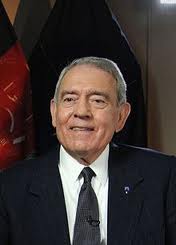
Dan Rather
(photo from Wikipedia)
In the days when TV was watched on a TV set, Dan Rather worked for CBS News as a journalist. He did his work the old-fashioned way: Rather built a story on a solid foundation of facts, he checked his facts, he really interviewed people, he went to the site of an incident, he told the story in a way that nearly any viewer could grasp. He understood how to put together a television news segment. The Texas-born Rather's career began in radio, which influenced his succinct delivery and ability to ad-lib. He also grew up the hard way, in a wrong-side-of-the-tracks Houston neighborhood. He was as far away from big-time internships and Ivy League pedigree as one could get.

Throughout his career, as Rather plainly states in his newly released autobiography Rather Outspoken, he remained dedicated to the public's need for the "truth." That concept can be a slippery one to embrace, as "truth" can often rely upon individual interpretation. Indeed, the conundrum of "interpretation" is at the heart of the current crisis in American journalism. Rather fought the good fight for high journalistic standards. He continues to do so today, via Mark Cuban's HDNet. However, even Rather concedes that HDNet is a long way from Black Rock.

I'm on the road a bit these days. While I wait for a flight, I sometimes watch TV at an airport gate. The news, or what passes for it, is inevitably on a screen. Almost everything I see, regardless of network, is dreadful. The experience makes me long for the time when CBS News was a worthy standard bearer of excellence. Those days have vanished, partly due, as Rather bitterly points out in his autobiography, to Viacom (and CBS) owner Sumner Redstone's greed and insensitivity to public service.

At least the 80-year-old, still vigorous Rather is trying to pass the torch via HDNet. His journalistic neighborhood, however, is a tough one. Conservatives have rolled over and played dead for a lurid amalgamation of fact and propaganda, of which Fox News is their soiled standard bearer. Many liberals have, to their shame, embraced the exploitative information plantation known as the Huffington Post or to preaching-to-the-choir talking heads. Major newspapers are in obvious decline, though their "brands" retain journalistic pedigree largely linked to their glorious past. Where will the next Dan Rather come from?


Sunday, October 2, 2011

Univision, Senator Marco Rubio, and Alleged Media Muscle

Media outlets have their ways of trying to get what they want. Generally, if there is any reporting of episodes involving media muscle, it's subdued. So, when an exception to the media's "look no evil, speak no evil, see no evil" approach to its peers' actions, it's a noteworthy event.

Senator Marco Rubio
That's what makes today's Miami Herald's story about Univision's  dance with US Senator Marco Rubio so fascinating. The newspaper's report carefully noted how a Univision news executive contacted Rubio's office with a deal he might not want to refuse. The Herald article alleges that, in exchange for a personal appearance by Rubio on a Univision national program, an unflattering story about a Rubio relative would "be softened or might not run at all."

Now, it's possible that interests opposed to Univision, or aligned with Rubio, provided useful details about this story. It's also entirely conceivable that the Herald published the article with good journalism as its sole rationale. What's much more interesting is Univision's motivation.

The Univision ploy, if the facts, inferential details, and likely conclusions hold water, is a vivid demonstration of a major media firm attempting to coerce an elected federal official for corporate gain. We've seen this scenario over the years in the business of celebrity journalism, in which extortion, blackmail, and other unsavory tactics are among the media's darker arts. Of course, politics is no stranger to these schemes. For the layperson, the Herald's story opens a fascinating window into how things really happen from the inside out.