 |
| The Ob River, the ship cited in the BBC report. (photo: Gazprom) |
Showing posts with label global warming. Show all posts
Showing posts with label global warming. Show all posts
Monday, November 26, 2012
Natural Gas Tanker Attempts First Winter Arctic Crossing


Friday, August 19, 2011
Plant, Animal Migration To Cooler Climates Accelerates
 A report published in the most recent edition of the journal Science asserts that plants and animals are accelerating their migration to cooler climates. The story was reported in today's Washington Post.
The report's researchers studied the movement of animals and plants in Malaysia, Europe, Chile, and North America. Their findings noted what were in many cases striking, dramatic mobility from warmer to cooler environments. However, opportunities for species movement are complicated. In a poignant observation, the climate science director for the Center for Biological Diversity said "mountain species, in particular, 'are struggling to keep pace' with global warming...'We're concerned many species won't be able to move quickly enough' -- or that they will run out of mountaintop to flee to."
Ironically, humans are going in the opposite direction of plants and animals. More people want to live in warmer climates, such as Florida's, versus Minnesota's. However, what if the plants and animals have the right idea?
Friday, July 1, 2011
Projected Warmer Weather Trends Threaten California Vineyards
 A recently released Stanford University study asserts that higher temperatures associated with global warming trends could negatively impact "high value" California vineyards. According to an LA Times story about the research, the hotter weather could cut approximately one-half of current wine production. The areas most likely to be affected would be Napa and Santa Barbara counties.
If the projected temperatures become an everyday fact, then the wine most severely challenged would most likely be Pinot Noir. This particular variety of grape is notoriously finicky about climate and soil. It typically grows best in cooler regions, with Burgundy being the paradigm. It's challenging for Napa wine producers to manage conditions for optimal Pinot Noir growth. A temperature increase would raise the odds of Pinot Noir wines being successfully cultivated in that region.
The hotter weather would also impact flagship Cabernet Sauvignon vintners that shape Napa's reputation for quality.
All this doom and gloom doesn't mean wine can't be produced in Napa or Santa Barbara. On the contrary. Wine does grow in hot weather climates, with Sicily, Spain, and Portugal being three prime examples. They do demonstrate a different character than their Burgundian competition. Reds from the Mediterranean's warmest regions are typically heavier and stronger than Pinot Noir. However, the financially daunting implications for vineyards would certainly cast a shadow over Napa's and Santa Barbara's wine business. New vines would have to be planted and nurtured over a number of years. Wines would require appropriate branding and acceptance from consumers. Some high-end vineyards would not be able to continue producing limited runs for an exclusive clientele.
I suppose the moral of the story is "get it while you can."
Thursday, March 31, 2011
Winter Arctic Ice Coverage Tied for Historic Low
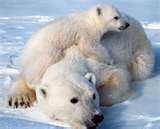 The blog's title sums up a piece that appeared, ironically, in today's Miami Herald. Among the disastrous impacts of the melting ice is a reduction of the environment where polar bears live. These creatures require solid ice for their survival. Most scientists attribute the diminished ice to the effects of global warming, which have been particularly pronounced at the poles.
Polar bears remain some of the world's most popular animals in captivity. Every zoo I've visited in the United States (ok, it's less than ten) included a polar bear. I don't recall seeing one at the Rome Zoo, a sorry Italian institution unworthy of the animals in its care. (It did have the distinction of placing the exhibit of deer next to that of the wolves -- a characteristically Roman touch.)
I wouldn't want the polar bear population limited to those in captivity. For everyone's sake, polar bears need to be in the wild and live freely.
Subscribe to:
Posts (Atom)


