Showing posts with label classism. Show all posts

Thursday, January 10, 2013

McDonald's vs. Starbucks

First McDonald's, Southern California
(photo from interesting story
in the UK newspaper Daily Mail
)
Fred Turner, a former chief executive at McDonald's, passed away recently. While I was reading his New York Times obit, I was struck by Turner's insistence on a simple success formula for fast-food restaurants: "quality, service and cleanliness." What was left out of his equation was "inexpensive." McDonald's and its fellow travelers tend to be the dining venue of choice for poor and working class people. Judging from McDonald's stock price, they seem to have struck a nerve.

The NPR/PBS crowd, generally speaking, doesn't like McDonald's. It's too low rent for their tastes. They're more inclined to visit Starbucks and linger over a made-to-order cup of coffee. I've even heard people argue that Starbucks is more "sophisticated" than McDonald's, although the evidence for that assertion seems to be based on a combination of expensive coffee, groovy music, and occasionally comfy seating.

What one pays for at Starbucks is brand perception. The message, similar to NPR's and PBS' "value proposition," is that it attracts a better class of citizens. How else does one explain an audience that rolls over and plays dead in exchange for no free wi-fi (something McDonald's does provide), dreadful pastries (far worse than anything McDonald's offers), and infrequent cleanliness (something Mickey D's plebians apparently are attentive to)?

First Starbuck's, Seattle
(photo: seattle.gov)
For the record, I happen to enjoy Starbucks and McDonald's. There's one Starbuck's style of flavored coffee I like sharing with my wife. I have a Starbucks app and, yes, I knowingly give my transaction data to the Seattle-based firm. Sometimes I meet the excellent writer Richard Torres in a Manhattan Starbucks. We talk for a long time, and we don't get hassled or thrown out.

I go to McDonald's every now and then. I have an unreasoned desire for their French fries, especially when I'm on the road. I like their Southern chicken sandwich and I trust their salads. (I profoundly mistrust salad bars.) McDonald's coffee is cheap and acceptable. The seating doesn't bother me. I also find it somewhat reassuring to be in a venue where children are welcomed, something Starbucks does not in its heart encourage.

I am fully aware of the "factory" nature of McDonald's food and atmosphere. However, I don't find Starbucks any different in those respects. Ironically, the adults who patronize Starbucks very likely grew up going to McDonald's. Sometimes, familiarity breeds contempt.


Friday, September 16, 2011

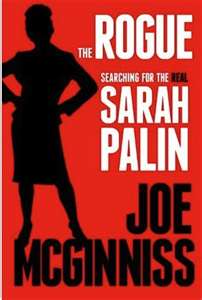
Joe McGinniss and the Disruptive Force Called Sarah Palin

Joe McGinniss' new book -- The Rogue: Searching for the Real Sarah Palin -- is making waves. Certainly that was the author's intent; who knows what plans his publicist, publisher, and other interested parties hatched. Someone leaked the book to the National Enquirer, which broke the story about its gossipy contents. (That reminds me of the wisecrack Tommy Lee Jones made in the first Men In Black movie, in which he picks up a copy of a supermarket tabloid and declares "Best investigative reporting on the planet!")

Personally, I find some of McGinniss' research tactics, especially renting the house next door to Palin's Alaskan residence, very creepy. There was absolutely no need to make such a provocative move in order to prepare a piece of investigative journalism. Reasonably and fairly, he has been publicly taken to task for this action.

Whatever the merits of McGinniss' work, the book doesn't get off the ground without readers' interest about the dirt on Palin's public and private lives. Do people want to know about her? I think so. Palin he has been a disruptive element from the start of political career. Her sudden emergence as a national political figure magnified her power to disrupt. She had a golden moment, in 2008, to disrupt a great many assumptions -- especially liberal ones -- about class and gender. She frittered the opportunity away, settling after the presidential election to embrace a "rogue" posture rather than pursue outsider substance.

That a noodnick Alaskan governor could so get under the skin of so many people fascinates me. Why would anyone care about Palin? After all, she's plainly unfit for higher office. Lots of men, such as Rick Perry, are unfit, too. However, they are not excoriated like Palin was, and continues to be. I've maintained for some time that the reaction to Palin was based on class perceptions. When Palin ran for the VP slot, I spoke with a number of confirmed GOP voters who were horrified by her. They could sit still for George W. Bush (twice), but couldn't envision voting for Palin. The principal reason came down to class: despite the many high-sounding arguments against her policy issues, the gut reason for the thumbs down was that she "wasn't like us." Palin sounded like someone from the wrong side of the tracks, and acted like someone who flaunted coming from the wrong side of the tracks. Women were particularly visceral in their disdain for Palin. Intriguingly, Palin's political views rarely came into play in these discussions. The disregard was about Palin as a person and her perceived class -- or lack of it. By contrast, Harvard-educated Barack Obama was someone the classists understood, or thought they did.

The election brought into play a stubborn reality in American politics: voters are not comfortable electing a woman to the presidency. Hillary Clinton encountered this force and it ultimately gave the edge to Obama. This point was not lost on Michelle Bachmann, who carefully studied Clinton's primary campaign and has used those lessons to shape her handling of the media. To the press' great shame, there was an inordinate focus during the 2008
primaries on Mrs. Clinton's appearance and clothing. Palin also experienced this treatment, although not to the same degree as Clinton did.

Instead, Palin's other, stealth aspect of disruption came into play. Palin was the first female presidential or vice-presidential candidate who had sex appeal. Men could look at Palin and sexually wonder about her. As reported in McGinniss' book, some didn't have to wonder. The book alleges some sexual encounters during Palin's lifetime, including one with a prominent college basketball player. Well, she's human, isn't she? And isn't that ok? However, I do concur with the notion that Palin's moral hypocrisy is annoying and off-putting.

For women, Palin's sexuality was more than just fodder for male leering: it was ominous. She was the younger, somewhat ruthless and aggressive competitor older and/or less attractive women dread. Palin wasn't a nerd, she didn't give a shit about Jane Austen novels, she could have dated the captain of the football team, and she got ahead and not necessarily on merit. This drove arrogant Maureen Dowd and other female classists to unreasoned distraction. Their vitriol toward Palin was, at times, astonishing and revealing of their class prejudices.

Ironically, Hillary Clinton had the best tactics for handling the Palin phenomenon. She simply suggested that people ignore Palin. The classists just couldn't follow that sage advice. Palin was their pinata, and all the classist abuse was hurled at it with full, furious force. Of course, Palin got the last laugh with a big contract from Fox and plenty of publicity, which was exactly what she wanted.

It will be interesting to see the reaction to McGinniss' book. The New York Times' book reviewer, the awful Janet Maslin, basically eviscerated it. (The review's smarmy headline is quite annoying.) To me, the review is a signal that the classists don't want to join forces with a writer whose book was first leaked to the National Enquirer. After all, that's the sort of publication a classist would assume Sarah Palin reads.


Wednesday, August 17, 2011

Abercrombie & Fitch's "Jersey Shore" Situation

Today's publicity stunt involving Abercrombie and Fitch and MTV's Jersey Shore series generated the attention both firms most devoutly desired.

However, it raised issues that ironically get to the malignant heart of both brands' success. According to The New York Times article on the manufactured flap, A&F offered to pay MTV so that Jersey Shore's actors would not be shown wearing its clothing. As A&F noted in a statement, "This association is contrary to the aspirational nature of our brand, and may be distressing to many of our fans."

If the fans are "distressed," then they have way too much time on their hands. However, A&F makes it clear the issue is entirely about social class. Jersey Shore is popular because it's a caricature of perceived lower class stupidity and foolishness. In the bad old days, condescending, demeaning shows used African-American caricatures as entertainment vehicles. That faded away in the aftermath of the Civil Rights movement. However, the mockery of lower classes has returned more or less in tandem with the recent, increased division of America into a "have" or "have not" society. Jersey Shore has successfully tapped into this unsavory zeitgeist, the same one that produces Abercrombie and Ken's "aspirational" branding.

Jersey Shore has something else in common with the old minstrel shows. Its principal character, Snooki, is "swarthy." She is as distant from the look of, say, Pippa Middleton or any number of pouty Russian blonde supermodels, as one can be. Snooki doesn't portray a very bright woman. She celebrates her grotesque cheapness, which enables an audience to indulge in feelings of class superiority. Snooki's dark complexion and moronic character are part of the "lower class" package, a backdoor form of racism that has morphed into classism.

Depressingly, American classism extends across ethnic lines, age, sexual preferences, and gender. It's now routine for American discourse to coalesce around assumed class structures. NPR, for example, has implied its audience's level of sophistication is essentially a matter of class. "Aspirational" fashion brands such as Ralph Lauren and Abercrombie and Fitch are entirely about social striving. Sex and the City was basically a valentine to decidedly unswarthy women whose greatest goal in life was to enjoy the bourgeois life of America's "aspirational" capital, Manhattan South of 96th Street.

A different Abercrombie and Fitch message was heard on Wall Street last week, when A&F announced quarterly earnings. As financial journalists often say, "analysts were disappointed," and A&F's shares promptly fell 8 percent. If that corporate performance continues in the same way, Abercrombie and Fitch may end up worn by the "wrong" people, seen in the "wrong" places, and perceived the "wrong" way. A&F will be on the wrong side of the social tracks, and they won't get Snooki and The Situation to wear their clothes. Even if Abercrombie and Fitch paid them.

The photo shows Jersey Shore cast members; the shrimpy woman is Snooki.