Showing posts with label New York Mets. Show all posts

Tuesday, December 17, 2013

Battle of the Brands: Robinson Cano vs NY Yankees

Robinson Cano in Seattle
(photo: sfgate.com)
The New York area's sports pages were recently roiled over the contract negotiations between the New York Yankees, its star second baseman Robinson Cano, his agent Jay-Z, and the Seattle Mariners. After considerable back-and-forth, Cano signed with Seattle for $240 million. This move led to consternation in New York, as if the Yankees, with an aging, suspect lineup, had stepped off a steep cliff.

From a talent perspective, Cano's move from Yankee pinstripes is unquestionably a loss for the team that calls The Bronx home. However, the negotiations were more than simply about the money. I think what soured the Yanks on Cano was Jay-Z's ploy to make his first MLB client a personal brand. The Yankees, in that scenario, were a splendid platform from which to launch the Robinson Cano product. The baseball team, with its own brand indissolubly linked to its successful, high-profile players, would not have been able to control the Cano brand. The notion that a player would be bigger than the team -- clearly Agent Jay-Z's talent management goal -- was something the Yankees could not tolerate. (Jay-Z's wife, Beyonce, recently demonstrated the clout of a personal brand with her no pre-publicity, iTunes exclusive release album. Yes, I think the Yankees watched that development quite closely.)

Jay-Z
(photo: npr.org)
The Yankees had experienced the emergence of personal branding in the early days of its contract with third baseman Alex Rodriguez. A-Rod had his eyes on branding from the start of his move from Texas to baseball's lucrative Northeast markets. The Yankees were not alone in that situation. Many fans forget that the New York Mets seriously entertained signing Rodriguez at the apogee of his on-field success. At the time, one demand from the Rodriguez camp was a personal marketing representative for A-Rod. In essence, he would develop and exploit his personal brand. This business scheme would have been under A-Rod's control, and quite separate from his team's success and marketing drives. The Mets could not or would not swallow this negotiating demand, and eventually took a pass on A-Rod's services.

Alex Rodriguez
(photo: Wikipedia)
While times have changed since Alex Rodriguez explored ways to create a personal brand, the lust for branded gold has accelerated. This year, common stock is now available in selected NFL players. You can purchase 100 shares of Houston running back Arian Foster, for example. Enterprises such as the Yankees have kept a close eye on these developments; my guess is that personal brands could significantly and irrevocably disrupt the teams' revenue and marketing plans. For star-driven teams such as the Yanks, the Los Angeles Lakers, and the Dallas Cowboys, personal brands are red flags. The Yankees just drew a line with Robinson Cano, so definitively that the team would willingly say adios to a tremendous, homegrown infielder at the prime of his career. The feeling was that "the Yanks didn't want to pay Cano." That's true, but misses the point. The Yankees are determined to maintain their brand. No player, not even Robinson Cano, could be permitted to be bigger than one of the world's great franchises, certainly not while on the Yankee roster. As for Jay-Z, the team sent a message: we don't need you and we don't want you. Tell your client to have a ball in baseball's version of marketing Siberia, far away from his natural Hispanic fan base, and even further from appearing in post-season play.

Hey, didn't Alex Rodriguez make his name in Seattle?

Saturday, November 2, 2013

Queens Reimagined: A Day at CitiField

Today's New York Times included an article extolling the virtues of living in the borough of Queens. The piece walked a line between "successful" new apartment developments, depressingly defined as a $2,000 per month studio, and "bargain" residences that included working fireplaces and enough elbow room to manageably raise a one-child family. In my lifetime, I have lived in two of the neighborhoods the journalist cited: Astoria and Sunnyside. One advantage each area offered residents was its affordability relative to Manhattan's zillionaires playground and the concept known as "Brooklyn".

Florent Morellet,
in front of his eponynous and long-closed restaurant
(Image: blogs.villagevoice.com)
In the same Times issue, a front-page piece talked about Florent Morellet's move to Brooklyn's freshly spawned "it" enclave, Bushwick. The Frenchman used to own a diner in the Meatpacking District that was fun to visit. He finally closed when the neighborhood denizens were fashionistas instead of transvestites and the rent on his establishment escalated beyond any reasonable sum. What became evident in the piece was how selective the notion of "Brooklyn" had become. The former Bushwick of food stamps, gangs, and bad schools was rapidly transforming into a hipster heaven, with wine bars, tablet-armed graduate students, and art walks. Morellet insightfully called this classist dreamscape New York's "East Bank," and he's right about that. (He's not always on the money: Morellet's reverie about the Cypress Hills neighborhood, one of the city's deepest, dreariest Siberian outposts, as resembling San Francisco has to be read to be believed.) Alas, there remains plenty of the Brooklyn the Times routinely ignores, especially the residents chained to foreclosure anxieties, underreported crime, and substandard services.

CitiField, home of the NY Mets baseball team
(Image: nycgovparks.org)
Queens rarely resembles Brooklyn, as I observed earlier this week during a business event at the CitiField baseball stadium. The conference focused on public school librarians' professional development; I attended as a book company sales representative promoting my firm's products. The gathering took place in a large dining/banquet room that included floor to ceiling windows overlooking my former home borough and, in the distance, midtown Manhattan. While the three-hundred-strong librarians listened to a prolonged James Patterson address, my attention drifted to CitiField itself and to the view beyond the ballpark.

Joan Payson Whitney with Casey Stengel (left)
Opening Day, Shea Stadium 1962
(image: artnet.com
original photo: Louis Requena)
This was my first visit to CitiField, and my first to a baseball stadium of any kind this year. (I usually make it a point to see one major league game in person during the season. This year was an exception.) The event's participants walked through the Seaver VIP entrance, named after a New York Mets' pitcher whose best years were nearly a half-century ago. (I can legitimately brag about how I saw Tom Seaver pitch a nearly perfect game in the searing heat of a pennant race against the Chicago Cubs in 1969.) The area featured other nostalgic reminders of a franchise leveraging its past to burnish its Madoff-tarnished present. One of my relatives was general manager of the Mets during their 1969 World Series championship season. (Yes, I did get free tickets and passes to the luxury dining area.) It was a different era, when a Whitney could own a baseball team because it was a sporting thing to do, like owning a race horse. Joan Whitney Payson took more than a sporting interest on which players stayed, played, or sat. Well, it was her team. She also brought Willie Mays back to New York, something my mother, who was raised in a baseball household, deeply appreciated.


Of course, those days are long gone. Looking out toward Flushing Bay, I could see a hint of the World's Fair Marina. It's not exactly anyone's dream getaway, with its proximity to LaGuardia Airport runways, scuzzy water, and a cheerless parkscape bounded by expressways and service roads. Yet, I knew a billiionaire (when there were precious few in the world at the time) who kept his yacht there. My first wife prepared meals for the money man, his wife, and their guests, onboard during the warm weather months. Sometimes, I got to sail on the vessel. Yes, it was nice. Those days are long gone, too.

Main Street, Flushing
(Image: nytimes.com)
A glance to the south showed the outline of the apartment tower where my teen years were spent; to the east, a Flushing where Caucasians enjoy Chinese food and Asians enjoy living. I considered dining there after the library event with my colleague, who had briefly lived in China. However, the grim reality of Queens' late-afternoon traffic created a sense of urgency to get out while we could.

I drove straight home, and wondered how the world had changed to the extent that public school librarians held a meeting at a baseball stadium during the World Series.


Tuesday, February 5, 2013

NY Mets' Owners Pitch for Queens Casino

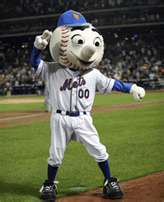
Mr. Met
Oh, those wild and crazy New York Mets have created quite a story for the back pages. The tale begins with the Metropolitans, one of Major League Baseball's premier franchises, pleading poverty in the wake of the Bernie Madoff affair. Their solution to this dilemma, however, does not involve improving the baseball team. Instead, according to an article in today's New York Post, Sterling Equities has made a pitch to build a casino adjacent to the Mets' ballpark, Citi Field.

Sterling Equities is the "development arm" of the Mets' owners, Fred Wilpon and Saul Katz. They've made a deal with a local Native American tribe to operate the gambling parlor. (Native Americans have a monopoly on table gaming in the Empire State.) Now, inquiring minds may ask how an Indian reservation was found about two miles from LaGuardia Airport. Well, there isn't one. The New York State Legislature would have to amend current statutes to permit table gambling in the Big Apple. Unsurprisingly, there's been some initial discussion in Albany addressing that very topic.

Now, before you can say "round up the usual suspects," keep in mind that Major League Baseball is highly allergic to any association with organized crime -- excuse me -- organized gambling. Further, New York governor Andrew Cuomo appears cool to the idea of a "family-style" gaming oasis in Queens. Gotham's legal games of chance currently focus on horse racing. Of course, illegal gambling is a major New York business. Why would anyone want to legalize such a lucrative money pot?

It's more than a little sad to see Citi Field pathetically empty during the height of a baseball season. The way to fix that depressing atmosphere is for Wilpon and Katz to put a better product on the diamond, rather than putting their money on a fixed casino game.

Sunday, December 30, 2012

S&P Downgrades NY Mets' Bonds

Will the bond degrade
mean curtains for Mr. Met? 
The New York Metropolitan Baseball Club, Inc., popularly known as the New York Mets, hit the dirt after receiving a chin-high fastball from Standard & Poor's. The rating agency knocked the Mets' bond rating down to the second level of "junk" status, Wall Street's equivalent of the Mendoza Line. The Mets' bonds are no longer "investment grade," which automatically prohibits certain pension funds, mutual funds, and other institutional buyers from purchasing these securities.

According to a bloomberg.com report, S&P raised concerns about the Mets' ability to meet certain revenue generation thresholds. It didn't take a wizard in financial modeling to realize empty seats and a lackluster squad equalled the proverbial downward slope for performance expectations. Considering the strength of the American corporate bond market, the downgrade is a disturbing event, one which Standard and Poor's and the Mets tried to bury during a slow, year-end holiday news period.

Overarching the ratings determination is the unspoken, but well known impact the Madoff scandal had on the Mets. The prevailing sentiment is that Madoff "made off" with much of the Mets' money. While the Mets' ownership has skated on this issue, the practical result has been the resemblance of the National League's #1 market to a small time operation. That is an unbecoming outcome, from which little good is likely to emerge.

Friday, January 6, 2012

New York Mets Hire Firm Specializing In Bankruptcy

Mr. Met
According to a story in today's The New York Times, the New York Mets have engaged the services of bankruptcy and financial restructuring specialist CRG Partners to "provide services in connection with financial reporting and budgeting processes." The baseball team immediately denied CRG was brought it to advise the team's besieged owners about how to navigate through dodgy fiscal issues, even though the firm handled the Texas Rangers' bankruptcy. Nope, the Mets just wanted some savvy numbers crunchers to join the party with Mr. Met in the House that Madoff Built.

The Mets, meanwhile, have reportedly been late on loan repayments to Major League Baseball. The baseball franchise will have a major bank loan payment due. There's no sign the team ownership has enough money to make the payments. In November, according to the Times article, the Mets laid off ten percent of its full-time staff. That's an astonishing act for a flagship baseball franchise in the nation's largest, most lucrative market.

It's no secret the Mets have traded away expensive players and did not make a bona fide effort to sign its star shortstop, Jose Reyes, at the end of the 2011 baseball season. He was merely the first Met to win a batting title. During the summer, the Met management made horse's asses of themselves by trying to get hedge fund sharpie David Einhorn to purchase a minority interest in the team. Einhorn, an outstanding poker player as well as a sharp value investor, didn't take long to walk away from whatever charm team owners Fred Wilpon and Saul Katz could muster.

Now, a once-proud franchise has been reduced to peddling pieces of the team to anonymous, presumably deep pockets. This turn of events is hard for me to swallow. When I was a young boy, I somehow talked the sponsor of our baseball team into naming it the "Mets." And, at one point in New York Mets history, a relative of mine was the team's general manager. Now, it's impossible for me to root for the team. Mets season ticket sales are evaporating. The Mets ownership may face a very tough court case with the feisty trustee representing victims of the Madoff scam. A bankruptcy specialist has been brought it, while employees are let go.

Who's next? Who knows. In the meantime, the team's song "Meet the Mets" takes on an ironic feeling, as there won't be anyone left at the Queens ballpark worth meeting. As for Mets fans, fuggedaboutit.


Friday, February 25, 2011

NY Mets to MLB: Hey Bud, Can You Spare $25 Million

The New York Mets baseball team, according to today's New York Times, tapped Major League Baseball for a $25 million loan late last year.

The loan was provided on the hush-hush to the Madoff-tainted franchise. The secrecy has raised eyebrows among many interested parties. Those include other major league baseball franchises (the Yankees must be having a very good laugh over this episode), the banks whom the Mets' owners have strung out to the tune of $400 million in IOUs, the team's sponsors, the players who must be wondering if Met ownership is solvent enough to meet its $140 million payroll, and the trustee of the Madoff mess who is suing the Wilpon/Katz empire for a cool billion dollars.

Yes, the Mets have issues. Spring training has just begun, and already "Let's Go Mets!" sound pretty hollow. It's going to be a very long, lonely season at Citi Field.