Showing posts with label NASA. Show all posts

Sunday, April 26, 2015

NASA Mission to Mercury Nearing Its End

Surface of planet Mercury
(Image: Science/AAAS)
For more images and thumbmail background information,
visit: http://messenger.jhuapl.edu/news_room/multi04.html
One of America's great gifts to the world is its space exploration program. Among its accomplishments was the Messenger spacecraft, the first vessel to orbit the planet Mercury. Messenger has transmitted invaluable data about the first planet from the Sun. The information, according to a recent Scientific American article, has reshaped concepts about Mercury. These developments are exciting, and one would understand why NASA would have an urge to take a victory lap in recognition of a job well done.

The greater triumph, though, is the scientists' dedication to answering questions about the solar system that have been around since the time of the Pharaohs. Nailing down "truth" is a complicated activity in any field; the Messenger mission is a reminder that these endeavors are more than worth it.

Monday, October 21, 2013

NASA "Misunderstood" Congressional Ban on Visiting Chinese Scientists

Congressman Frank Wolf (R-VA)
(Image: radio.foxnews.com)
NASA recently found itself in the middle of a mindless congressional diktat involving Chinese scientists. According to a story in the BBC, the issue was not the scholars as much as a regulation initiated by a zealous, right-wing Virginia representative who controls NASA's budget. The GOP lawmaker, Frank Wolf, crafted legislation that forbids Chinese nationals from visiting any NASA facility. Supposedly, NASA "misunderstood" the intent of Rep. Wolf's directive; he asserted it did not include scientific gatherings, such as an upcoming conference on the Kepler Space Telescope at NASA's Ames Research Center.

Bullshit. Wolf provided his "interpretation" only after the Chinese raised official hell over the incident and prestigious American scientists prepared to boycott the high-profile event in protest over its evident discrimination. Meanwhile, Wolf still calls the People's Republic of China a communist country. He's not entirely wrong on that score, in fairness. However, there are other ways to maintain American security besides embarrassing political stunts that principally serve to diminish our legitimate national pride in our political values.

Sunday, July 21, 2013

Amazon Deepens Reach into Federal Contracts

In March 2013, I wrote a blog post about Jeff Bezos' Amazon juggernaut landing a contract to handle CIA data storage and related data management needs. The Seattle-based firm muscled out IBM to win the deal. IBM squawked and had the contract assignment reviewed.

Reuters reporter Alistair Barr has followed up on the contretemps. His piece, which was picked up by the Mercury News, notes the impact of the shock waves the Amazon cloud computing triumph on Old School tech firms, including "Big Blue," as IBM is sometimes known.

The story quoted some investment analysts for attribution. They noted how AWS -- the heart of Amazon's cloud computing initiative -- allegedly strongly shapes Amazon's current stock market valuation. Reuters' Barr grasps the notion that Amazon is really a tech company, an inconvenient fact most journalists ignore. To that end, his article cites AWS' impact on Oracle, cloud computing competitor Rackspace Holding, Microsoft, and other tech heavyweights.

Barr also cites some of AWS' publicly identified clients. One of them is NASA, which, as with the CIA, happens to be involved in highly classified operations. (An ironic aspect of this situation is that Jeff Bezos recently sponsored the retrieval from the Atlantic Ocean of what he claimed were Apollo 11 rockets. A related report and images appear in a gizmodo.com post.)

Another AWS client is PBS. Inquiring minds are wondering why a federally and viewer-subsidized media outlet requires Amazon's cloud computing clout. (In late 2011, PBS and Amazon signed a deal in which PBS would show some of its programming on Amazon Prime.)

What's most interesting in the increased coziness of the Obama Administration's bureaucracy and Amazon is why it's happening at all. Just don't expect that story to appear on the News Hour anytime soon.


Monday, June 4, 2012

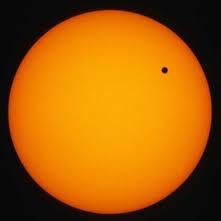
Transit of Venus Excites New York Area's Star Gazers

Transit of Venus (black dot) across the Sun
(2004 photo from Scientific American)
The transit of Venus, in which the Sun, Earth, and herself are in alignment along the same plane, will take place starting tomorrow evening. The rare event will be theoretically visible from New York area vantage points. I say "theoretically," because the weather forecast features rain and clouds. That's not exactly an ideal formula for astronomical action.

Still, the event is an exciting one, and as The New York Times reported, many people are preparing their varieties of visually safe telescopes to view the transit. You want to get in on the event now; the next transit will occur in the 22nd Century.

According to NASA, there have been 53 transits since 2000 B.C. Yet, despite the rarity of the event, it remains very important for astronomers. In the 18th Century, scientists used the transit to rather accurately measure the distance between the Earth and the Sun, also known as the Astronomical Unit. In an age of computers and handheld calculators, it's refreshing to note that some sharp estimates about profound distances were managed without machine assistance.

Sunday, March 11, 2012

Venus and Jupiter To Pass In the Night Sky

Venus Transiting the Sun (NASA photo)
A story in today's online editions of the BBC noted upcoming occurrences of planetary passages that will excite even the most amateur of astronomy buffs. This month, Jupiter and Venus will be in close visual conjunction with one another. As the BBC article noted, the passage will be among many during this rich period of astronomical events. The highlight will be in early June, when it will appear in some parts of the world that Venus is passing in front of the Sun.

The wonder of it all is that this episodes are available for free. All you need is your eyes and a clear night sky. I observed the phenomenon earlier this evening, watching an airplane fly exactly between the two planets. Except for the plane, I could see what generations preceding ours saw, and what those generations that follow us will also see.

Sunday, January 15, 2012

Europe's Great Astronomical Venture -- the Planck Telescope -- Nearing its End

Orion. Photo taken by Planck Telescope.
With all the world's troubles reaching occasional fever pitches, it's comforting to know that scientists continue to explore and expand our shared knowledge of the universe.

A case in point is the Planck Telescope. This spacecraft was launched in 2009 by the European Space Agency (ESA) with the mission of "mapping the oldest light in the Universe," according to a recent BBC report. The British article noted that the telescope, which has delivered far more than anticipated, is reaching the end of its functional ability.

The details about the mission are remarkable. For the Planck Telescope to properly work, its instruments have had to operate in temperatures well below 250 degrees Centigrade. At its most extreme, the telescope functioned within one-tenth of a degree above absolute zero. I don't have any scientific background, but the telescope's ability to work in such extraordinary environments strikes me as just slightly south of the miraculous.

The telescope's mapping features are fascinating in their own right. I can't pretend to explain them, but the BBC story discusses them in reasonably accessible terms for laypeople to grasp. One profound area of research Planck scientists contemplated and researched was a notion called "inflation." The concept, as the BBC article noted, is a "'faster-than-light' expansion that cosmologists believe the Universe experienced in its first, fleeting moments." It also touched on the idea of "ancient light," or elements that existed long before the Age of the Dinosaurs, or before anything we could possibly associate with our planet (including its own existence).

As the late British scientist J.B.S. Haldane (shown in photo) famously said, "My own suspicion is that the Universe is not only queerer than we suppose, but queerer than we can suppose."

I'll second that motion.

Thursday, September 15, 2011

NASA Kepler Mission Discovers Double Sunset

NASA's Kepler mission, intended "to explore the structure and diversity of planetary systems," recently discovered a planet orbiting two stars. One consequence of the planet's position is that it experienced double sunsets. This phenomenon, something of a staple in popular science fiction, has now been established as scientific fact. (Kepler, by the way, is the name of a 17th Century German mathematician and astronomer.)


The image, from NASA, shows the Kepler spacecraft.

Tuesday, March 29, 2011

First Orbiter Image of the Planet Mercury

Our solar system, a locus of fascination throughout human history, begrudgingly reveals its mysteries. Today's NASA release of the first image taken of Mercury's surface by an orbiting spacecraft is a splendid milestone for our understanding of the fiery planet. (The initial NASA announcement of the spacecraft's successful orbiting of Mercury is a useful, brief background piece.)

NASA will be releasing more photos in the coming days. I'm looking forward to seeing them, even if they're more images of cratered surfaces.

When one thinks about the subject, it is astonishing that a transmission can be accurately delivered through light years of space, accurately recomposed on Earth, and instantly shared with the world via the Internet. The ancients, who had powerful intellectual capabilities, could not have imagined such a trio of accomplishments. However, they would have appreciated the exploration of the planets. Just about any civilization that could look into the sky has used planetary orbits and relationships as a basis for their deepest thoughts. What's amazing is their ability to have very accurately measured planetary appearances and movements without the aid of instruments, such as telescopes. It did take brains, and thinkers from antiquity had that in abundance.

In a way, the NASA scientists have kept faith with what the ancients so deeply desired. Both groups used the sky's phenomena to unlock profound ways of thinking, delivered through astronomically based intellectual tools such as geometry. You can leverage the sky as well. Best thing about the sky is that it remains free, and free of charge.

The image shows the Messenger Moi spacecraft which is currently orbiting Mercury.

Saturday, November 6, 2010

Hartley 2

Looking up has its rewards, as NASA dramatically demonstrated this week.

The space agency released splendid photographs of the comet Hartley 2 taken by NASA's EPOXI mission spacecraft. These images offer a rare look at this type of celestial object. The investigation is intellectually significant, partly because some scientists speculate that information about a comet's composition provide clues into the creation of the solar system.

I wouldn't know; I'm not an astronomer. I do like looking into the night sky and opening myself to wonder. The NASA photographs bring the sky to earthlings, encourage us to reason about the universe, help us appreciate what we have, and what unknowns we might still understand.