Since 2010, I have written a blog called "Inner Harbor." The posts tend to be a vehicle for my reactions to current events. I typically comment on issues or incidents promiscuously discussed in social or traditional media. Certain posts involve episodes whose root was either an immediate, personal incident or a reflection on some aspect of my own life. In some cases, I comment on people or contexts which aroused my curiosity, but were otherwise unknown to me.
"Inner Harbor" began when my wife, the fine art photographer Amy Becker, suffered a serious illness. My posts were intended as a daily commitment to our love and firm belief in each other's talents. Every post offered an opportunity for her to hear my voice and witness its growth. Without Amy's strong encouragement and visceral commitment, I would not have developed "Inner Harbor," nor used that blog as a vehicle to generate a style and voice suitable for a creative journey.
I believe I have now achieved "Inner Harbor's" purpose. This summer, I stopped writing in "Inner Harbor." At that time, I came around to the notion that nonfiction could not adequately represent contemporary issues. "The rule of law" crowd, through its ruthless use of intimidating litigation and restrictive legislation, made nonfiction writing a debilitating exercise in risk management. Having people speak "on the record" has become an excruciatingly difficult task for even the most skillful or highly placed writers. Public discourse became a realm where spin doctors, investigative wolves, and data "scientists" commanded the media's high ground. Entertaining distortions took precedence over intelligently presented fact, something exploited most shamefully via "reality TV" and political propagandists.
This degradation of rationality compelled my move into writing mystery/detective stories. This pulpy world has historically, successfully been viewed as a portal into depictions of contemporary reality. Fiction allows the weaving of character, context, and motive in useful, and yes, entertaining ways. Coinciding with ceasing "Inner Harbor" posts, I read a number of Italian crime novels. The ones I have read embrace a mixture of reportage and fiction -- exactly the formula I wanted to pursue. Their sharply drawn characters struck me as entirely, unsentimentally real. And the books integrated current events, such as human trafficking and institutional corruption, with men, women, and children whose flaws and strengths displayed the writer's and audience's interest in humanity that no software wizard could "engineer."
I look forward to the challenge of creating work worthy of these Italian writers, along with iconic American detective novelists whose work I admire. Whatever I do, I will have also fulfilled advice my father offered me on his deathbed. He held me hand firmly and asserted that I should pursue fiction writing.
It took me a generation to embrace my father's perspective. I'm ready now to begin that journey to create work into a world Raymond Chandler aptly characterized as one where "the streets were dark with something more than night..." To that end, "More Than A Fresh Corpse" will be a blog/sketchbook for this effort.
Showing posts with label Amy Becker. Show all posts
Showing posts with label Amy Becker. Show all posts
Sunday, November 22, 2015


Sunday, October 16, 2011
Amy Becker's Photos at Hunterdon Art Museum


The show's official opening was today, and we attended in our best New York black outfits. Also worth noting is the statement from the show's juror, Trong G. Nguyen. His thoughtful statement thankfully avoided art world jargon.
I am interested, Nguyen wrote, in the completeness of an artwork. During the jurying process, and when I visit exhibitions in general, I ask myself
one simple question that initially determines whether an artwork will have the chance to resonate with me -- "Is this a complete work of art?" If I find myself at pause or unable to immediately answer this question then that answers a lot for me. However, if I find myself engaged and intrigued, with both my mind and eye, then this says something quite different....Works of art are inquiries into the curiosities of the artist, as well as a subsequent interrogation of these interests. While interrogation is routinely seen as a necessary tactic of law enforcement, in the realm of art the exhaustion of such a strategy is often sought and revered as insight into the mind of the working artist. Harsh interrogative techniques may be a form of extremity, but works that go out on a limb and make me question them usually earn my full respect.
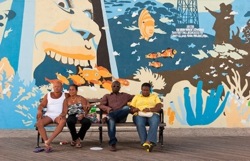
(From left to right: Tunnel Girl, Four on a Bench, Happy Hour.)


Sunday, September 18, 2011
Ray's Pizzeria and St. Mark's Bookstore, Two New York Icons, to Vanish
 |
| Ray's Pizzeria on Prince Street, New York |
According to The New York Times, the Saint Mark's Bookstore can't swing the $20,000 monthly rent its landlord, Cooper Union, is requiring. The university's rather cool response to the notion that an important independent bookstore might bring more to the community than whatever might replace it is a telling one. Essentially, the school needs money; that consideration trumps intellectual nourishment.
Further downtown, the first of the various Ray's Pizzerias is calling it quits. Its story is a bit more complicated, including celebrity sightings, alleged organized crime links, and the demise of Little Italy. The New York Times covered the story, noting how the transformation of Manhattan South of 96th Street into a sort of Disneyland for zillionaires and tourists has "modified" the City's social and commercial fabric.
 |
| Photo by Amy Becker -- All Rights Reserved |
The photo shows a view of the Cyclone ride in Coney Island; the fearsome creature is no longer there. While the Cyclone has been kept on life support by New York's Parks Department, the squalid, vivid Casbah atmosphere that was its spiritual home has been homogenized into a much duller amusement park.
Enough said: read the linked stories.
Sunday, August 21, 2011
Enjoying Coney Island While It's Still There
 My wife, the photographer Amy Becker, and I visited one of our favorite New York destinations -- Coney Island -- yesterday. It was an ideal time to visit, with the weather reasonably, rather than unbearably, warm. Recent rains briefly cleaned New York's polluted sky, making the sea breezes and salty tang in the air that much more inviting. People dancing on the boardwalk were loose, rhythmic, and not trying too hard to have a good time. We were far away from political nuttiness and fiscal fecklessness, at least for a day. The scene felt good.
Unfortunately, the forces of "progress" have Coney Island in its sights. Plans exist to turn the beachfront into a homogenized hotel/condo zone. This year, the City of New York trial ballooned the notion of using concrete rather than wood on the boardwalk's surface. City spokespeople maintained cement would be safer and cheaper than screwed boards. The comments did put into focus just how much the money mattered more than any other consideration.
One wonders if Coney Island will share Times Square's fate. Many years ago, the "Crossroads of the World" was sanitized and morphed into a backdrop for morning television programs. Coney Island's carny personality would not survive a "Times Square" treatment. That would be a significant loss for all of us.
Walking through Coney Island yesterday suggested that the unwelcome process of "development" had already made significant inroads into the area. The amusement park looked wholesome, lacking the Casbah atmosphere it had as recently as two years ago. It is as if the equivalent of a Baron Haussmann transformed Coney Island's narrow alleys and funky streets into clean, easily managed, strangely charmless thoroughfares. Coney Island's poetry became harder to identify, but the sales fulcrum was all too easy to see.
That's a shame. For the price of a subway ride, New Yorkers have free beach access, an historic boardwalk, and an amusement park available to them at Coney Island. New York's iconic beach destination also serves as a reminder that New York faces the Atlantic Ocean, a fact not at all evident in Times Square. Most significantly, New Yorkers from those countries the Atlantic touches --such as Ireland, Morocco, Senegal, and Brazil, just to name four -- can freely mingle at Coney Island. They can dance, drink, get goofy, work on a tan, or enjoy the sea's benign aspects. In fact, the very lack of rules at Coney Island reminds one of what once made New York great -- its disdain of boundaries, its ethos of enjoying the moment, its atmosphere of expectation, its moments of tolerance. In contrast, contemporary New York feels much too calculated, and it's just too expensive in the Big Apple to attempt anything involving risk (except Wall Street's hunger for risking other peoples' money). The consequences are notable in the arts, in which more and more energy and ideas are originating beyond Gotham, while New York arts events seem more like oppressive coronations than exciting, ground-breaking adventures.
Ishmael Reed, in his new novel Juice!, compared Manhattan to a Disneyland marked with recurring episodes of what he characterized as "ethnic cleansing" (such as the migration of poor minorities from the Lower East Side and their replacement with prosperous classists). One gets an ominous feeling that the same destiny awaits Coney Island's beachfront. As my wife took photographs of the here-and-now Coney Island, we reflected that many structures from only a couple of years ago had vanished. Her photographs this weekend were taken with a sense of urgency. We both acknowledged that, next year, Coney Island might lose more of its outsider personality. The only unchanging aspect, which soulless developers cannot expunge, will be the ocean and its musical, eternal rhythm.
The photograph above, which my wife took yesterday at Coney Island, shows me wearing a "Bee Positive" shirt.
Thursday, June 9, 2011
Miami Fans Put HooDoo on Big D
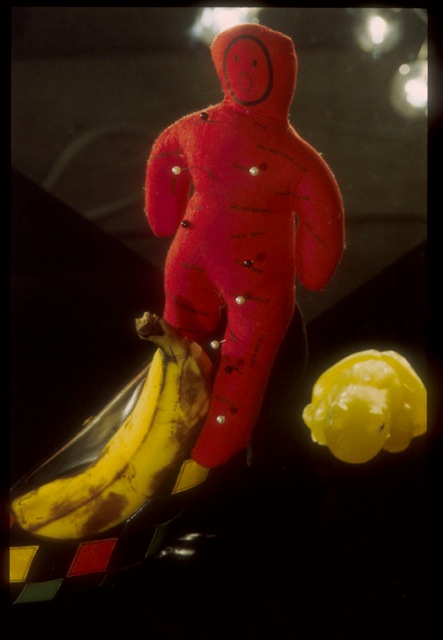 When the New Orleans Saints made their Super Bowl run a couple of years ago, a few stories emerged about certain locals' use of voodoo to help their team win the championship. Of course, the Crescent City has an historic association with these "underground religious practices," as Wikipedia characterizes it.
Miami's version of the dark arts comes from Haiti, and is called vodou. Now, fans of the Miami Heat are buying vodou items to help the team win the NBA title. It's a breath of fresh air in a sport dominated by footwear endorsement packages.
Monday, May 30, 2011
Decoration Day
 In our time, Memorial Day has two purposes: to acknowledge the sacrifice of men and women in the armed forces and to serve as the unofficial launch of the summer season. Previous eras in American history took a more solemn view of the day's significance. The day was a holiday by decree, rather than a "natural" holiday such as New Year's Day. It began in the post-Civil War era, and was called Decoration Day. While the day's name gradually shifted over the following decades to Memorial Day, it retained its hold on May 30th as the celebratory date.
In 1971, federal legislation called the "Uniform Holidays Bill" shifted Memorial Day to fit into the demands of a three-day holiday weekend. Some, including veterans groups, feel this date change has diminished the holiday's resonance with a population that coincidentally has largely done its best to avoid military service.
Many still retain a strong feeling for Memorial Day. Flagman, an image taken by my wife, the photographer Amy Becker, that suggests the depth of this sentiment. The man in the photograph found the flags left on the street after a parade. He took them home, washed the flags, and displayed them.

If you enjoy post-war blues, Sonny Boy Williamson's Decoration Day is a way to go, although the harmonica player's conflicts were more domestic than nationalistic.
Monday, June 14, 2010
Reflections on My Wife's Studio Tour
My wife Amy was part of our town's artist studio tour yesterday. Her participation meant the first floor of our apartment was turned into a venue for a one-person exhibit. She didn't accomplish this venture alone: Donna Compton generously spent hours organizing the images and giving Amy's opus its conceptual logic and presentation oomph.
I thought I knew the images well. I've been present for the shooting of nearly all of the nearly seventy hung pictures (hey, find your own link for off-color jokes!) and nearly as many photographs contained in bins. Over the years, Amy and I have discussed the images. I've understood her thinking as she modified them in a darkroom or via Photoshop. We've discussed further directions her photographs might go. Yet, their unique magic almost -- almost -- seems hopelessly elusive to me.
Sometimes, I know what she saw the moment she snapped the picture. That's a very satisfying feeling. However, more often than not, Amy saw something that required her innate talent to grasp, and grasp immediately, without reflection or calculation. When I look at them now, I don't know how she did it, even though I was a witness and intimately aware of my wife's thinking. For someone who cares about the person, the artist, the photograph, this puzzling feeling leaves one wondering how much one can truly understand about any person, and about the act of creation itself.
Subscribe to:
Posts (Atom)


